


Sometimes the hardest part of the workday isn’t the work.
It’s the deadline that suddenly gets moved up.
The meeting where you’re expected to present without much notice.
The manager who checks on your progress for the third time today.
The project that changes direction after you’ve already spent hours getting it right.
The performance review sitting on your calendar next week.
The disagreement with a coworker you can’t stop thinking about.
The vague announcement about “organizational changes” that leaves you wondering whether your job is safe.
Any one of these could be a normal part of working. They can also be incredibly activating.
And when we’re triggered by them, we may tell ourselves that we should be able to handle it. It’s just a deadline. It’s just feedback. It’s just a meeting. Everyone else deals with this.
But knowing intellectually that something is part of work doesn’t necessarily change what happens inside us when we experience it.
That’s what I want to talk about: why certain workplace situations can trigger such strong responses, what those responses might be telling us, and what becomes possible when we begin to recognize our own patterns.
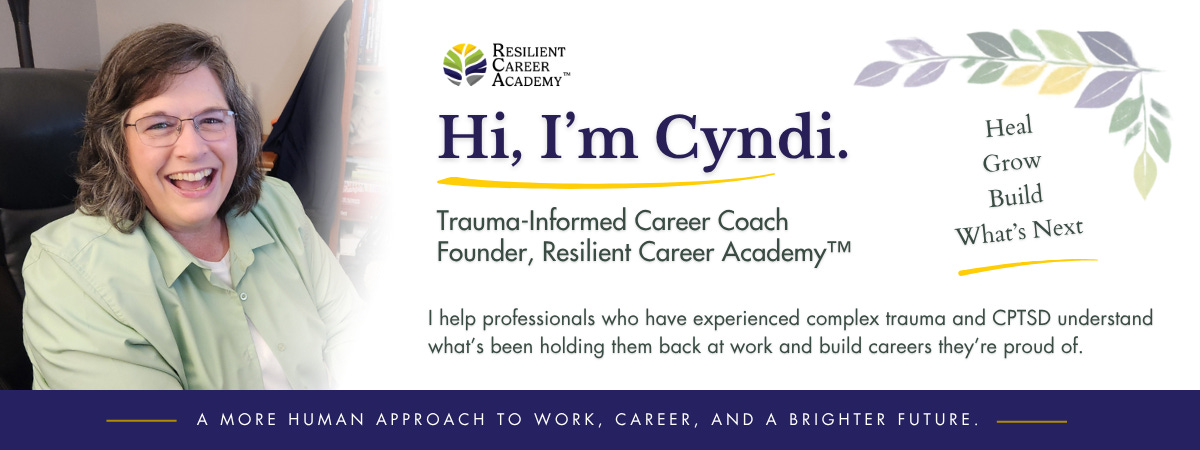
If we haven’t met, I’m Cyndi Bennett. I’m a trauma-informed career coach, founder of the Resilient Career Academy™, and a trauma survivor myself.
I spent more than 25 years working inside corporate America, and much of the work I do now focuses on something I wish more of us talked about: the ways our past experiences can follow us into the workplace and quietly shape how we respond to pressure, feedback, uncertainty, conflict, authority, and the everyday demands of our jobs.
That’s why I think workplace triggers are worth talking about. Not because we need to eliminate every uncomfortable reaction we have at work, but because understanding what activates us can give us more awareness and more choice about what happens next.
What Do We Mean When We Say We're “Triggered” at Work?
The word triggered gets used pretty casually. We might say a frustrating email triggered us, a coworker got on our nerves, or a difficult meeting ruined our day. But when I talk about workplace triggers, I mean something more specific.
A workplace trigger is a situation, interaction, or experience that sets off a strong internal response. Something happens in the present, but our reaction may be influenced by what that experience represents to us, what it reminds us of, or what we have learned could happen next.
And that distinction matters.
A tight deadline can simply be stressful. But for someone whose sense of safety has become connected to getting everything right, that deadline might activate an intense fear of making a mistake.
Micromanagement can be irritating. It can also leave someone feeling watched, controlled, or unable to trust their own judgment.
A change in priorities can be inconvenient. For someone who has learned to rely heavily on predictability, that unexpected change may create a much stronger sense of uncertainty or loss of control.
And criticism can be difficult for almost anyone to hear. But if criticism has historically been accompanied by humiliation, rejection, punishment, or shame, even constructive feedback in the workplace can sometimes activate a response that feels much bigger than the conversation happening in front of us.
That doesn’t mean every strong reaction we have at work is rooted in trauma.
Sometimes we’re stressed.
Sometimes we’re exhausted.
Sometimes we’re dealing with unreasonable expectations, poor leadership, unfair treatment, or a genuinely unhealthy workplace.
Our reactions can also give us important information about what is happening around us.
That’s why I don’t think the most useful question is immediately, “Is this a trauma response?”
I think we can start somewhere simpler:
Something happened. I had a reaction. What can I learn by getting curious about both?
We don’t have to judge the reaction, explain it away, or decide immediately whether it belongs to the past or the present.
We can begin by noticing it.
And when we start paying attention over time, we may begin to see that certain situations, people, dynamics, or experiences at work consistently create a stronger response for us.
Those patterns are where workplace trigger awareness begins.
Workplace Triggers Can Come From More Places Than We Realize
When we think about being triggered at work, we may immediately think about the obvious moments: a difficult conversation with a manager, conflict with a coworker, harsh criticism, or someone treating us poorly.
But workplace triggers can be much less obvious.
A deadline can be a trigger. So can an unexpected change in plans, unclear instructions, being interrupted repeatedly, having too much work and not enough time, being asked to speak in front of a group, or waiting for the results of a performance review.
Even things that might look positive from the outside can be activating. Being recognized for our work can increase our visibility. Being offered a new opportunity can create uncertainty. Getting promoted can change our relationships with coworkers and put us in a position where more people are watching, evaluating, or depending on us.
What makes this complicated is that the same workplace experience won’t necessarily trigger everyone in the same way, or for the same reason.
A manager who frequently checks on our progress might activate feelings of being watched or controlled.
A vague assignment might leave someone else feeling anxious because they don’t know exactly what is expected of them.
A disagreement with a coworker might create an intense urge to restore the relationship as quickly as possible.
A heavy workload might activate the belief that we have to prove we can handle everything without asking for help.
Sometimes the trigger isn’t even the event itself. It is what the event seems to threaten.
Pressure and performance can bring up fears of making a mistake, failing, disappointing someone, or not being good enough.
Power and control can show up through micromanagement, rigid policies, authority figures, or situations where we have little say in what happens next.
Relationships and belonging can be affected by conflict, criticism, office politics, exclusion, lack of recognition, or changes in how someone interacts with us.
Uncertainty and unpredictability can come from unclear expectations, changing priorities, organizational changes, poor communication, or concerns about job security.
And capacity can matter too. Excessive workloads, constant interruptions, technology problems, competing priorities, and too little time to recover can leave us with far less capacity to navigate something that might feel manageable on another day.
This is one reason simply asking “What triggers me?” may not go far enough.
We can also become curious about:
What is it about this situation that feels difficult for me?
Is it the possibility of failure? The loss of control? Being evaluated? Disappointing someone? Not knowing what is going to happen? Feeling excluded? Being visible? Having to depend on someone else?
We don’t have to know the answer immediately. In fact, we may discover that two situations that look completely different on the surface activate something very similar underneath.
And that’s where tracking our triggers can become useful. Instead of looking at each difficult workday as an isolated experience, we can begin noticing what repeats.
That pattern may tell us much more than any single trigger ever could.
What triggers you at work?
Sometimes we know we’ve had a strong reaction without recognizing exactly what set it in motion. And because our workplace triggers are personal, what activates one person may barely register for someone else.
I created the free Workplace Trigger Tracker Toolkit to help you identify the situations that may be triggering you at work, track what happens when you’re activated, and begin noticing the patterns that repeat.
Why Can an Ordinary Workplace Situation Feel So Intense?
One of the most confusing things about workplace triggers can be the difference between what is happening around us and what is happening inside us.
We may know that the deadline is manageable. We may understand that our manager is allowed to ask questions about our work. We may even recognize that the feedback we’re receiving is reasonable.
And still, something inside us responds as though much more is at stake.
For those of us with a history of complex trauma, that response may make more sense when we consider what our nervous system has learned from previous experiences.
Our brains and bodies are constantly taking in information and trying to determine what deserves our attention. Past experiences can influence that process. If certain situations once came with consequences, we may become especially sensitive to cues that suggest something similar could be happening again.
That doesn’t require the present situation to look exactly like something from our past.
The connection might be how the experience feels.
Being micromanaged may bring up a familiar sense of having no control.
Being criticized may activate an old expectation that making a mistake will have consequences far beyond the mistake itself.
Unclear expectations may create the feeling that we’re responsible for getting something right without being given enough information to know what “right” is.
Conflict may feel less like two professionals disagreeing and more like a relationship is suddenly at risk.
In those moments, our response isn’t necessarily waiting for us to consciously evaluate all the evidence.
We may feel the tension in our body before we have words for what is happening. We may want to explain, fix, withdraw, defend ourselves, work harder, make someone happy, or regain control before we’ve consciously decided to do any of those things.
That’s part of what can make a trigger feel so immediate.
But there’s another piece I think is important.
The intensity of our response doesn’t automatically tell us whether the situation is safe or unsafe.
Sometimes our past is influencing how we’re experiencing the present. Sometimes something genuinely concerning is happening at work. And sometimes both things are true at the same time.
Our goal isn’t to talk ourselves out of our reactions or assume, This is just my trauma.
It’s to create enough space to become curious about what we’re experiencing and what is actually happening around us.
We can begin asking:
What am I feeling right now?
What does this situation seem to mean to me?
What do I actually know about what is happening?
Is there something here that needs my attention, or is my system anticipating something that hasn’t happened?
We may not know the answers immediately. That’s okay.
Because emotional regulation isn’t about becoming unaffected by difficult things at work. It’s about developing more capacity to stay with ourselves long enough to understand what is happening before an automatic response decides what we do next.
And sometimes, the first sign that an automatic response has taken over isn’t how we feel.
It’s what we find ourselves doing next.
What Being Triggered at Work Can Look Like
When we hear the word triggered, we might picture an obvious emotional reaction. Maybe someone becomes visibly upset, panics, gets angry, or needs to leave the situation.
Sometimes it does look like that.
But being triggered at work can be much harder to recognize, especially when we’ve become very good at continuing to function while we’re activated.
We might leave a difficult meeting and immediately start working harder. We double-check everything we’ve done, stay later than we planned, or decide that the next deliverable has to be flawless.
We might start explaining. A simple question about our work turns into a five-minute answer because we want to make sure the other person understands why we made the decision we did. Or we send the follow-up email with three more paragraphs of context, just in case.
We might become agreeable. We say yes to the additional assignment even though we’re already overwhelmed. We change our opinion when someone pushes back. We apologize even when we’re not sure we’ve done anything wrong.
Or we might go in the opposite direction.
We get quiet. Stop contributing in meetings. Put off responding to an email. Avoid the coworker we had a disagreement with. Decide not to volunteer for the opportunity we were excited about yesterday.
Sometimes we become defensive or irritable. Sometimes we can’t concentrate. Sometimes we spend hours thinking about what happened, rehearsing what we should have said or trying to predict what might happen next.
And sometimes we simply keep working.
That’s one of the reasons these patterns can be difficult to recognize.
We can look completely functional on the outside while expending an enormous amount of energy managing what is happening on the inside.
For high-performing professionals, some of these responses may even be rewarded.
Working harder can look like dedication. Perfectionism can look like having high standards. Taking on more can look like being a team player. Staying quiet can look like being easy to work with. Constantly anticipating problems can look like exceptional preparation.
Those behaviors may have helped us succeed. They may also be skills we’ve genuinely developed and value.
The question isn’t whether every instance of working hard, preparing carefully, helping someone, or choosing not to engage in conflict is a trauma response.
The question is whether we still have choice.
Am I staying late because I’ve decided this work needs additional attention, or because making a mistake suddenly feels intolerable?
Am I saying yes because I genuinely want to help, or because saying no feels unsafe?
Am I preparing thoroughly because it serves me, or because I don’t believe I’m allowed to walk into the room unless I’ve anticipated every possible question?
Am I choosing not to respond right now because that’s the best decision, or because I feel unable to respond?
The behavior can look exactly the same from the outside.
What is happening inside us can be very different.
That’s why noticing what we do after we’re triggered can give us valuable information. We aren’t looking for another list of behaviors to judge or eliminate. We’re beginning to recognize when a response feels automatic and when we have enough space to choose it.
Because once we can see what happens after the trigger, we can begin working with what happens next.
Start With Recognition, Not Judgment
Once we begin recognizing these patterns, it can be tempting to turn that awareness into another reason to criticize ourselves.
Why do I always do this?
I should be able to handle feedback by now.
I need to stop overthinking everything.
Why can’t I just say no?
I know better than this.
But noticing a pattern and judging ourselves for having it are two very different things.
Many of the responses we’ve been talking about developed for a reason. Working harder, anticipating what could go wrong, keeping the peace, staying quiet, getting everything exactly right, or trying to remain in control may have helped us navigate situations where those responses made sense.
We don’t have to shame ourselves for learning them.
And we don’t have to immediately get rid of them either.
We can start by becoming curious.
The next time you notice yourself having a strong reaction at work, see if you can slow the experience down enough to ask:
What happened?
What did I notice happening inside me?
What did I think this situation meant?
What did I immediately want to do?
What did I actually do?
The goal isn’t to come up with the “right” answer. It’s to begin collecting information.
Maybe you notice that unclear expectations consistently make you want to work harder and prepare for every possible outcome. Maybe conflict creates an immediate urge to apologize or make things okay. Maybe being questioned makes you start explaining yourself. Maybe unexpected change makes you feel as though you need to regain control as quickly as possible.
One moment may not tell us very much.
But when we begin noticing these experiences over time, patterns can emerge.
And patterns give us something an isolated reaction often doesn’t: context.
We can begin to see not only what triggers us, but what tends to happen next. We may even start recognizing the moment when a familiar response begins taking over.
That awareness matters because we can’t make an intentional choice about something we haven’t learned to recognize yet.
So if you notice one of these patterns in yourself, we don’t need to begin with:
How do I stop doing this?
We can begin with:
That’s interesting. What is happening here?
Sometimes curiosity creates just enough space for another possibility to become visible.
We Can't Always Control the Trigger. We Can Learn to Work With the Response
We can’t control everything that happens during a workday.
Deadlines will change. Managers will give us feedback. Coworkers will disagree with us. Priorities will shift. We may be asked to do things before we feel completely ready. There will be uncertainty, pressure, difficult personalities, mistakes, misunderstandings, and circumstances we didn’t choose.
And sometimes, those experiences are going to trigger us.
The goal isn’t to become so emotionally regulated that nothing at work ever affects us. I don’t think that’s realistic, and I’m not sure it would even be desirable. Our reactions can give us important information about what we need, what matters to us, what feels uncomfortable, and what may require our attention.
What can change is what happens after we’re activated.
There can be a difference between feeling the urge to immediately defend ourselves and deciding whether a response is actually necessary.
Between noticing the impulse to say yes and giving ourselves time to consider whether we want to.
Between feeling afraid that we’ve made a mistake and automatically working until midnight to prove that we’re competent.
That space may be very small at first.
Sometimes the win is simply noticing, I’m triggered right now.
We may still overexplain. We may still say yes. We may still spend the afternoon replaying the meeting. But now we’ve recognized something we might not have recognized before.
The next time, perhaps we notice the response a little earlier.
Over time, we can learn ways to help ourselves regulate when we’re activated. We can become more familiar with the thoughts, sensations, and behaviors that tend to signal that something has been triggered. We can learn to slow down before responding when the situation allows it. And we can get better at looking at both what we’re experiencing internally and what is actually happening around us.
None of that requires us to ignore our instincts or convince ourselves that everything is fine.
Sometimes the conclusion we reach after we’ve had time to regulate will be, Yes, something about this situation really isn’t okay.
The difference is that we’re giving ourselves a better opportunity to decide what we want to do with that information.
That’s where I think emotional regulation can become especially powerful in our careers.
It isn’t about controlling every feeling or eliminating every trigger. It’s about building more capacity to choose our response instead of automatically repeating the one we’ve learned to rely on.
And that process starts much earlier than changing the response.
It starts with recognizing the trigger.
You Don’t Have to Figure Out Every Trigger Today
Understanding our workplace triggers doesn’t happen all at once. And the goal isn’t to create a list of everything we need to avoid at work.
The first step is simply to notice.
The next time something at work creates a stronger reaction than you expected, get curious.
What happened?
What were you feeling?
What thoughts showed up?
What did you feel compelled to do next?
Over time, those individual moments can begin to reveal patterns. And once we can see a pattern, we have more information to work with and more opportunity to choose how we want to respond.
That’s why I created the Workplace Trigger Tracker Toolkit. It’s a free resource designed to help you identify potential workplace triggers, capture what happens when you’re activated, and begin recognizing the patterns that may be affecting how you experience work.
You don’t need to change anything yet.
the belief shifts you describe are usually the last thing people credit for the change, but they're doing the most work. you can update tactics all day — it's the underlying belief about what you deserve or what's possible that actually moves things.
Such an important and timely topic. Understanding the difference between intellectualizing workplace stress and actually managing the internal response is crucial.