Have you ever had a reaction to your boss that felt much bigger than what was actually happening in the moment?

I have. I had been with the company for almost 22 years when a manager told me she wanted me to start accounting for my time.
By that point in my career, I was a tenured senior leader. I knew how to manage my workload. I knew how to get my work done. No one needed me to account for how I spent every hour of my day before.
But my response to her request wasn’t simply, I disagree with this management approach.
It felt much bigger than that.
I felt insulted. Controlled. Diminished. It felt like I had suddenly gone from being a capable professional who had spent more than two decades building a career to being a child who couldn’t be trusted to manage herself.
And that intensity was information.
Because my manager wasn’t the first authority figure I’d encountered in my life.
Long before I had bosses, managers, performance reviews, deadlines, or corporate hierarchies, I learned what it meant to live with adults who held power over me. My nervous system learned to pay attention to control, criticism, expectations, unpredictability, and the possibility of getting something wrong.
So when I encountered some of those same dynamics at work, my nervous system didn’t necessarily experience them as isolated workplace interactions.
Sometimes, it recognized something familiar.
And I don’t think I’m alone in that.
For those of us with histories of complex trauma or CPTSD, our relationships with authority at work can carry more weight than anyone around us realizes.
A manager’s tone, a request for a meeting, unexpected feedback, being questioned about a decision, or even a message that says “Can we talk?” can activate a response that seems much bigger than the situation in front of us.
That doesn’t mean we’re overreacting.
It also doesn’t automatically mean our boss is doing something wrong.
It may mean there is more information our nervous system is responding to than what is happening in this particular moment.
And learning to recognize that difference can matter enormously for our careers.
Because the goal isn’t to make ourselves impossible to trigger.
The goal is to understand what’s happening well enough that an automatic response doesn’t have to be our only response.
That’s where we begin to create choice.
Before We Go Any Further, Let Me Introduce Myself
If we haven’t met yet, I’m Cyndi Bennett. I’m a trauma-informed career coach, and I help professionals understand how the after-effects of complex trauma and CPTSD can show up at work and create obstacles in our careers.
But I don’t come to this work only as a coach.
I’ve spent more than 25 years building my own career in corporate America while navigating many of these patterns myself. For years, I didn’t understand why certain workplace situations seemed to affect me so differently, or so much more intensely, than they appeared to affect the people around me.
It wasn’t until my own childhood trauma surfaced later in life that I began to recognize something I hadn’t understood before: the survival responses we learned long before we ever had a career don’t necessarily stay at home when we go to work.
They can show up in how we respond to feedback, conflict, authority, visibility, boundaries, expectations, and even success.
That’s what much of my work is about today.
I help us get curious about those patterns without judging ourselves for having them, understand what may be underneath them, and explore what becomes possible when an automatic survival response doesn’t have to be our only response.
Because I’ve experienced these patterns in my own career, too.
Including with my bosses.
Why Authority Can Feel Different When We Have a History of Complex Trauma
A boss isn’t just another person we interact with at work.
They may have influence over our workload, our performance reviews, our opportunities, our compensation, our reputation, and sometimes whether we get to keep our job.
There is a real power dynamic built into the relationship.
For those of us who experienced complex trauma in childhood, power and authority may already carry a history.
The first authority figures in our lives were the adults we depended on for safety, care, protection, and survival. When those relationships were also a source of fear, control, criticism, neglect, unpredictability, or harm, we may have learned very early that being around someone with power required us to pay attention.
We learned to notice changes in tone.
We learned to anticipate what someone might need before they asked.
We learned to avoid mistakes, keep the peace, stay out of the way, become indispensable, or figure things out on our own.
Those responses may have helped us navigate the environments we grew up in.
And then we went to work.
Suddenly, we’re in another environment with hierarchies, expectations, evaluations, consequences, and people who have some degree of power over what happens to us.
Our circumstances may be completely different, but something about the dynamic can feel familiar.
A manager who closely monitors our work may activate an old response to being controlled. A boss who is difficult to read may leave us scanning for signs that something is wrong. Critical feedback may feel like more than information about our performance. An absent manager may activate the familiar belief that when we need help, we’re going to have to figure it out on our own.
And sometimes, we may find ourselves working incredibly hard to stay in an authority figure’s good graces by saying yes, overdelivering, avoiding disagreement, or trying to become the employee they could never be disappointed in.
None of this means every difficult interaction with a boss is about our past.
It means our past may be one of the things our nervous system brings with us into the interaction.
And that can help explain why two people can walk out of the exact same meeting having experienced it very differently.
One person may leave thinking, That was uncomfortable.
Another may leave with their heart racing, replaying every word, wondering what they did wrong, worrying about their job, or already figuring out what they need to do to make things okay.
The meeting may be over.
But their nervous system may still be responding to what it believes is at stake.
Your Nervous System May Hear Something Your Manager Didn’t Say
Have you ever received a message from your boss that simply said:
“Do you have a few minutes to talk?”
That’s it.
No explanation. No context. Just a request to talk.
And suddenly, your mind is off to the races.
What did I do?
Did I miss something?
Are they upset with me?
Am I in trouble?
Am I going to lose my job?
By the time the meeting happens, we may have replayed our last several interactions, reviewed everything we’ve worked on recently, and prepared ourselves for a conversation that hasn’t even happened yet.
Then we get on the call, and our manager says, “I wanted to get your thoughts on this project.”
Nothing was wrong.
But the response we experienced before that conversation was real.
This is one of the ways our past experiences can shape what we hear in the present.
Our manager may say, “I’d like you to make a few changes to this.”
We may hear, “You didn’t do it right.”
They may say, “I noticed something I want to give you some feedback on.”
We may hear, “You messed up.”
They may disagree with an idea we proposed.
We may hear, “Your ideas aren’t valuable.”
They may make a decision we don’t understand.
We may hear, “You don’t matter here.”
The words our manager actually says and the meaning our nervous system assigns to those words aren’t always the same thing.
And that doesn’t mean we’re making it up.
Our nervous system has learned from experience. If criticism once came with humiliation, if mistakes had consequences that felt dangerous, if someone’s changing tone told us we needed to prepare for what was coming next, or if keeping an authority figure happy helped us feel safer, it makes sense that we became really good at noticing those cues.
The challenge is that the meaning we learned to assign to those cues may continue showing up long after our circumstances have changed.
That’s why I think curiosity is so important here.
Instead of immediately asking ourselves, Why am I reacting like this?, we can begin asking:
What did my manager actually say or do?
What meaning did I attach to it?
What did I immediately believe was going to happen next?
And what about this feels familiar?
Those questions aren’t about talking ourselves out of our response.
They’re about getting more information.
Because sometimes our nervous system is responding to an old alarm.
Sometimes it’s picking up on something happening in the present that deserves our attention.
And sometimes it may be a little bit of both.
The more we can understand what we’re responding to, the more choices we can begin to see about what to do next.
What Boss Triggers Can Look Like at Work
Once we start paying attention, we may notice that it isn’t simply our boss who triggers us.
It may be something specific about the way they lead, communicate, respond, or use their authority that our nervous system recognizes.
And different behaviors may activate very different responses.
Control or Micromanagement
Being closely monitored, having our decisions questioned, or feeling like we constantly have to account for what we’re doing can be especially activating if control was part of our earlier experiences.
We may find ourselves becoming angry or defensive. We may shut down. We may feel an overwhelming need to prove that we’re capable. Or we may comply while quietly feeling smaller and smaller.
That was part of what was happening for me when my manager asked me to account for my time.
It wasn’t simply the request.
It was what the request seemed to say about whether I could be trusted.
Criticism or Perfectionism
For some of us, getting something wrong wasn’t always safe.
Maybe mistakes were met with anger, humiliation, punishment, withdrawal, or expectations we could never quite meet. We may have learned that doing things perfectly was one way to reduce the possibility of what might happen next.
Then we encounter a manager who focuses heavily on mistakes, expects perfection, or continually moves the bar.
Suddenly, a correction to a presentation or a piece of feedback on a project can feel like much more than feedback.
It can feel like evidence that we’ve failed.
Yelling, Anger, or Changes in Tone
Sometimes the trigger is much easier to recognize.
A boss raises their voice. Slams a door. Sends an angry email. Becomes visibly frustrated.
But it doesn’t always have to be that obvious.
For those of us who became skilled at monitoring other people’s emotions, even a subtle change in our manager’s tone, facial expression, or communication style may be enough to put us on alert.
We may notice the shift before anyone else in the room does.
And then we may start preparing for what we believe is coming next.
Unpredictability
A manager is warm and supportive one day and critical the next.
Priorities constantly change. Expectations aren’t clear. We never quite know which version of our boss is going to show up.
For a nervous system that learned to survive by anticipating what was coming next, unpredictability can keep us scanning.
Instead of focusing only on our work, part of our attention may always be trying to answer:
Are we okay today?
Favoritism or Unequal Treatment
Watching a manager give someone else opportunities, attention, flexibility, or approval that we aren’t receiving can bring up more than frustration about workplace fairness.
It may activate an old drive to earn approval.
We may start working harder, volunteering for more, saying yes more often, or trying to figure out what we need to become in order to finally be seen as valuable.
An Absent or Unavailable Manager
Not every authority trigger comes from someone exerting too much control.
Sometimes it’s the opposite.
A manager who is rarely available, doesn’t provide direction, or isn’t there when we need support may activate something entirely different.
We may immediately default to:
I’ll figure it out myself.
That independence can look like a strength, and often it is a strength.
But sometimes underneath it is an old expectation that when we really need someone, they aren’t going to be there.
These are only a few examples.
The point isn’t to create a checklist of behaviors that should trigger us. It’s to begin noticing our own patterns.
What happens inside us when our manager questions us?
What happens when they disagree with us?
What happens when they’re disappointed?
What happens when they don’t respond?
What happens when they have something we need, such as approval, information, support, an opportunity, or a decision, and we have to wait?
Those moments can give us clues.
Because when we stop at “My boss triggers me,” the problem can feel enormous and almost impossible to change.
But when we become curious about what specifically is activating us, what response it creates, and what that response may be trying to protect us from, we have something we can begin to work with.
Is This an Old Alarm, a Present Problem, or Both?
Recognizing that our past may be influencing our response doesn’t mean we should automatically assume the problem is ours.
Sometimes our nervous system is responding to something that feels familiar from the past.
Sometimes our manager is behaving in a way that really is controlling, demeaning, unpredictable, inappropriate, or harmful.
And sometimes both things are happening at the same time.
This distinction matters.
If I become activated when my manager questions a decision I’ve made, I can get curious about why being questioned feels threatening to me. Maybe I learned that making a mistake could lead to criticism, humiliation, or consequences that felt much bigger than the mistake itself.
That’s useful information about me.
But it doesn’t tell me everything I need to know about what is happening now.
I can also look at the present situation.
How did my manager question me?
Was I being asked to explain my thinking, which may be a reasonable part of working with a manager?
Was I spoken to disrespectfully?
Is this an isolated interaction, or is there a pattern?
Are expectations clear and reasonable?
Am I being treated differently from others?
Is there something happening here that I need to address, document, set a boundary around, or get support with?
This is where getting curious can help us separate the different pieces of the experience.
We don’t have to dismiss our response as just a trigger.
And we don’t have to assume that because we feel triggered, our interpretation of what’s happening is the only possible interpretation.
We can hold space for both the past and the present.
We can ask ourselves, What does this remind me of?
And we can also ask, What is actually happening here?
Those two questions can give us very different information.
The first can help us understand the response our nervous system learned.
The second can help us evaluate the situation we’re in now.
And together, they can help us decide what we need.
Sometimes that might mean regulating ourselves and approaching the situation differently. Sometimes it might mean having a conversation, asking for clarification, setting a boundary, documenting a pattern, seeking support, or considering whether this environment continues to work for us.
The goal isn’t to convince ourselves that everything is safe.
The goal is to get enough information to make a choice based on what is happening now, rather than having the past make that choice for us.
We Can’t Always Control the Trigger. We Can Learn to Work With the Response.
One of the things I’ve had to learn in my own career is that recognizing my triggers doesn’t mean they stop happening.
I can understand exactly why something activates me and still feel my nervous system respond when it happens.
My heart may start racing. I may feel defensive. I may want to shut down, get away, explain myself, prove myself, fix the situation, or immediately do whatever I think will make everything okay again.
The trigger can happen quickly.
What I’ve learned is that I don’t have to make my next decision just as quickly.
When we’re activated, there can be an enormous sense of urgency. We may feel like we need to respond to the email right now, explain ourselves right now, confront our boss right now, fix whatever went wrong right now, or start looking for another job right now.
But urgency is something we can learn to notice, too.
When possible, we can give ourselves enough space to get grounded before deciding what to do next.
That might mean stepping away from the computer for a few minutes. Taking a few slow breaths. Going for a walk. Writing down what happened. Talking with someone we trust. Or simply reminding ourselves, I don’t have to figure this out in this exact moment.
Once there is a little more space between the trigger and our response, we can begin getting curious.
What happened?
What did my manager actually say or do?
What happened inside me?
What did I feel in my body? What thoughts showed up? What did I immediately want to do?
What meaning did I give the interaction?
Did I hear criticism as I’m not good enough? Did a question feel like I can’t be trusted? Did someone’s frustration become I’m in trouble?
What does this remind me of?
Is there something familiar about the feeling, the dynamic, or the response?
And then we can come back to the present.
What choices do I have now?
That last question matters.
Because the response that once helped us survive may still show up automatically, but automatic doesn’t have to mean inevitable.
We may not get to choose whether our nervous system reacts.
We can practice creating more choice in what happens next.
This is the beginning of what I teach through my 5 R Framework:
Recognize the pattern,
Root out the cause,
Rebuild the response,
Rehearse it live, and
Reinforce for good.
It starts with noticing.
Not judging the response.
Not shaming ourselves for having it.
Not demanding that we stop being triggered.
Just recognizing what is happening and getting curious about why.
Because awareness alone doesn’t change a career.
But awareness can create the space where a different response becomes possible.
Start by Noticing the Pattern
If you’re beginning to recognize some of your own workplace triggers as you’re reading this, you don’t have to figure them all out at once.
Start by noticing.
What happened?
What did you feel?
What did you immediately believe the interaction meant?
What did you want to do next?
And what, if anything, felt familiar about it?
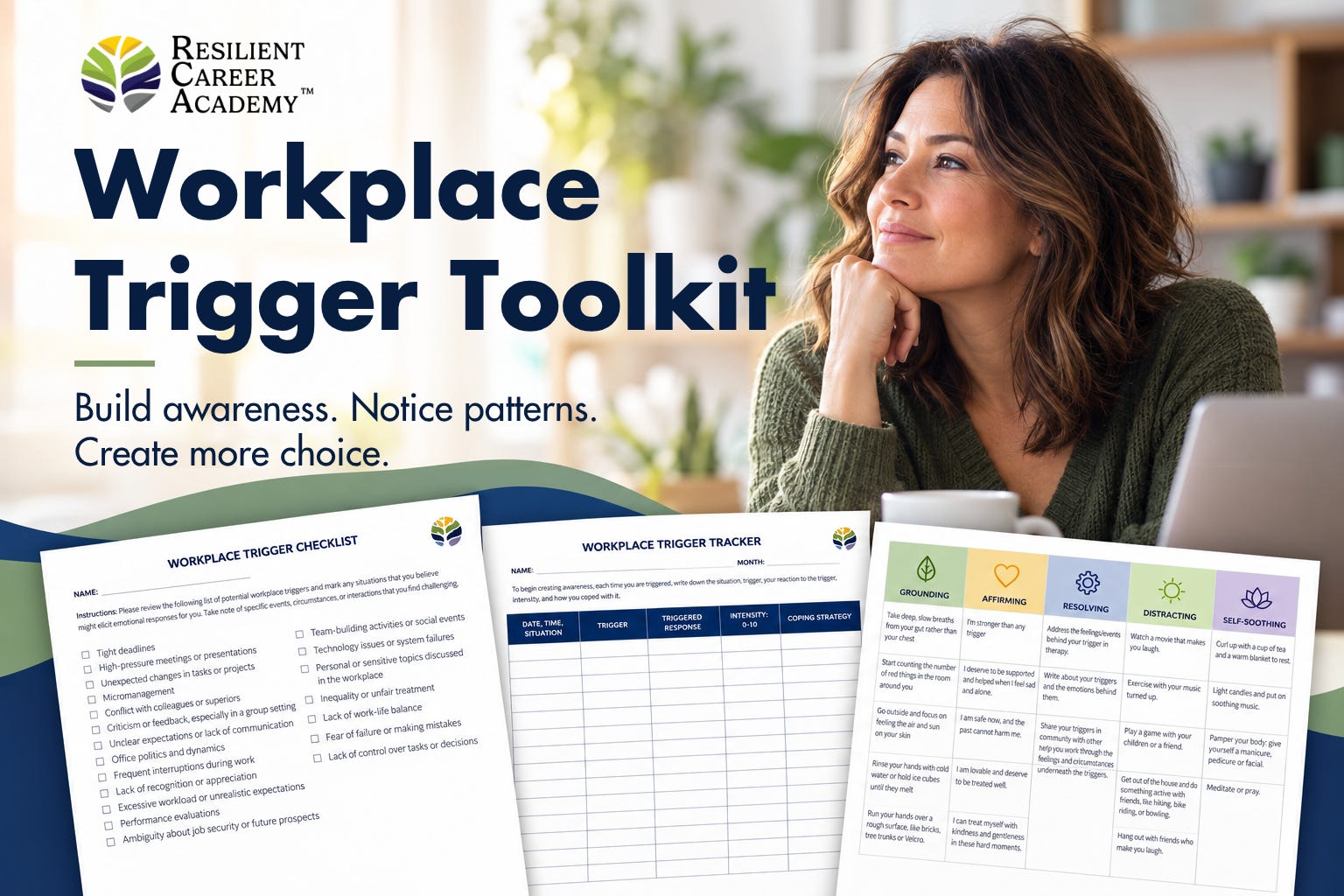
I created the Workplace Trigger Tracker Toolkit to help us slow these experiences down and begin looking for the patterns that can be difficult to see when we’re in the middle of them.
Instead of simply walking away from an interaction thinking, My boss triggered me again, the Trigger Tracker can help us get more specific about what happened, what response it activated, and what we may need in order to navigate similar situations differently in the future.
We don’t have to use what we discover to judge ourselves.
We can use it to get curious.
Because every time we recognize a pattern, we have another opportunity to understand what our nervous system has been trying to do for us and consider whether that same response is what we need now.
We May Have More Choices Than Our Nervous System Realizes
One of the hardest things about being triggered by someone in authority is that, in the moment, we may not feel like we have very many choices.
We may feel like we have to comply.
We may feel like we have to keep them happy.
We may feel like we have to defend ourselves, prove ourselves, fix the situation, or get away from it.
Sometimes leaving the job may feel like the only way to make the feeling stop.
I understand that response.
When many of these patterns were first formed, we really may not have had many choices.
As children, we couldn’t simply decide that an authority figure’s behavior wasn’t working for us and find another family. We couldn’t schedule a meeting to clarify expectations, talk to Human Resources, set a workplace boundary, ask for a different assignment, look for another job, or decide how much access someone would have to us.
Our options were limited, so we learned ways to adapt.
We kept the peace.
We became easy to manage.
We stayed quiet.
We anticipated what other people needed.
We became exceptionally capable.
We handled things ourselves.
We learned how to survive within circumstances we couldn’t necessarily change.
Those responses may still show up when we’re sitting across from a boss today.
But our circumstances are different now.
That doesn’t mean every option available to us is easy, safe, or without consequences. Workplace power dynamics are real. Financial realities are real. There may be very good reasons why we aren’t ready or able to confront a manager, leave a position, or make a significant change.
Choice doesn’t mean pretending those realities don’t exist.
It means recognizing that there may be more than one possible response available to us.
Maybe we ask our manager what they meant instead of trying to interpret it ourselves.
Maybe we give ourselves time before responding to an email.
Maybe we ask for clearer expectations.
Maybe we disagree respectfully.
Maybe we stop automatically saying yes.
Maybe we document behavior that concerns us.
Maybe we seek guidance or support.
Maybe we set a boundary.
Maybe we decide that something isn’t ours to fix.
And sometimes, after looking carefully at what is happening, we may decide that leaving really is the choice we want to make.
The difference is that leaving doesn’t have to be an automatic escape from the feeling of being triggered. It can be an intentional decision based on what we know about ourselves, what we’re experiencing, what we need, and what we want for our careers.
That’s the possibility I keep coming back to in this work.
We aren’t trying to become people who never have a trauma response again.
We’re creating more space between what happens to us and what we do next.
And sometimes, in that space, we discover choices we couldn’t see before.
From Automatic Response to Intentional Choice
When I think back to that manager who asked me to account for my time, I can understand my response differently now.
I can see why it felt so much bigger than a request about how I spent my workday.
It touched something familiar.
It activated feelings around control, trust, authority, and whether someone else believed I was capable of managing myself.
Knowing that doesn’t mean I have to convince myself that I was wrong to be upset. It doesn’t mean I have to decide that my manager’s approach was reasonable. And it doesn’t erase the very real frustration I experienced in that situation.
It gives me more information about me.
And with more information comes more choice.
That’s what I wish I had understood much earlier in my career.
For a long time, I thought my options were determined by what happened around me. If someone triggered me, I responded. If an authority figure made me feel threatened, I protected myself in whatever way had worked before.
Sometimes that meant overworking.
Sometimes it meant proving myself.
Sometimes it meant staying quiet.
Sometimes it meant handling everything myself.
And sometimes it meant wanting to get as far away from the situation as possible.
Those responses weren’t random. They had a history.
But they don’t have to determine the future of my career.
And neither do yours.
Imagine being able to walk out of a difficult meeting and, instead of immediately assuming you’re in trouble, recognize: Something about that interaction activated me. Let me figure out what happened.
Imagine receiving feedback and being able to notice the part of you that wants to defend, explain, shut down, or prove yourself without automatically having to follow that response.
Imagine recognizing that your boss is disappointed with something you did and knowing that their disappointment doesn’t have to determine what you believe about yourself.
Or realizing that your manager really is behaving in a way that isn’t acceptable to you and being able to consider your options from a grounded place.
That doesn’t mean the trigger disappears.
It means the trigger doesn’t automatically get to decide what happens next.
This is what I mean when I talk about moving from automatic response to intentional choice.
We recognize what’s happening.
We get curious about where the response may be coming from.
We look at what is actually happening in the present.
And then we ask:
Given what I know now, how do I want to respond?
There may not always be a perfect answer.
But there may be more possibilities than we could see when our nervous system was focused on protecting us.
And every time we create a little more space to see those possibilities, we get to participate more intentionally in what happens next in our careers.
What Might Become Possible With More Choice?
Being triggered by our boss can affect much more than one uncomfortable interaction.
It can shape how visible we’re willing to be, whether we speak up, how we respond to feedback, the boundaries we’re willing to set, the opportunities we pursue, and even whether we stay in a job or leave it.
That’s why learning to understand these responses matters.
The goal isn’t to become unaffected by everything that happens at work. We’re human. We’re going to have reactions. And for those of us whose nervous systems learned to protect us through difficult experiences, some workplace situations may continue to activate those protective responses.
What can change is what becomes possible after we’re activated.
We can learn to recognize what is happening.
We can get curious instead of immediately judging ourselves.
We can create space to distinguish what belongs to the past from what is happening in the present.
And we can practice choosing a response that reflects what we need and what we want now.
That practice can change more than how we interact with a difficult boss.
It can change how we experience our careers.
If You’d Like to Go Deeper
If you’ve been reading this and thinking, I can recognize my triggers, but I don’t always know what to do once I’m activated, that’s exactly the gap I created Emotional Regulation in the Workplace to help us work with.
This six-week, self-paced course explores how dysregulation can show up at work and gives us practical tools for building self-awareness, coping with activation, communicating and setting boundaries, strengthening resilience, and navigating our careers with more intention.
Because recognizing the pattern is important.
Learning what to do when the pattern shows up is where we begin to practice something different.
And if you’re not ready for the course, that’s okay.
Start with the free Workplace Trigger Tracker Toolkit. Use it the next time something at work activates you and see what you notice.
You don’t have to change everything at once.
Sometimes the next step is simply being able to say:
I recognize what’s happening.
I understand a little more about why.
And I have choices about what I do next.
That’s a powerful place to begin.