


Do you remember learning how to ride a bike?
Maybe you started with training wheels.
And with those training wheels on, you could ride. You weren’t thinking about balance or wondering whether you could stay upright. You climbed onto the seat, put your feet on the pedals, and took off.
Maybe you rode up and down the sidewalk or raced the other kids in the neighborhood. You learned to steer around cracks in the pavement and how hard you had to push the pedals to climb a hill. You might have even gotten pretty fast.
You knew how to ride your bike.
Until someone decided it was time to take off the training wheels.
Suddenly, the bike you had been riding confidently felt like an entirely different machine.
There was nothing on either side to catch you if you leaned too far. The bike wobbled underneath you, and something you had felt perfectly capable of doing five minutes earlier suddenly didn’t feel so certain.
Could I really do this without the training wheels? What if I fell? What if I couldn’t do it?
Maybe you weren’t convinced. So someone offered to hold onto the back of the seat.
They would give you a little push to get you started, then run alongside you while you pedaled. And once you had a little momentum, something wonderful happened. You could balance! You could steer, pedal, and keep the bike upright without the training wheels.
As long as you were moving, you were fine.
The hard part was getting started.
When the bike was standing still, with one foot on the ground and the other on the pedal, it was a different story. You had to push off, get your feet onto the pedals, and build enough momentum to balance before the bike tipped over.
That was the scary part.
So you asked for another push.
And every time, once you were moving, you could ride. You were doing the pedaling, the steering, and the balancing.
But you still believed you needed someone holding the back of the seat to get you going.
Until one day, the person helping you did something you weren’t expecting.
They gave you that familiar push, but instead of running alongside you, they let go.
You kept pedaling, gripping the handlebars and concentrating on staying upright. You were so focused on riding that you didn’t notice anything had changed.
Until you realized you couldn’t hear their footsteps anymore.
You looked back.
They were standing halfway down the sidewalk, watching you.
They hadn’t been holding on for a while.
You’d been riding the bike by yourself.
And that’s the part of this story that has me thinking about our careers.
Because I wonder how many of us have spent years learning, growing, developing skills, and accomplishing things we once weren’t sure we could do, yet still approach every new challenge as though we’re that child gripping the handlebars, terrified that we’re going to fall.
What if we’ve already demonstrated that we’re capable?
What if the person we’re still trying to convince is ourselves?
Before We Go Further, Let Me Introduce Myself
I’m Cyndi Bennett, a trauma-informed career coach and Founder of the Resilient Career Academy. I help survivors of complex trauma and CPTSD recognize the patterns that may be holding them back, rediscover the strengths and capabilities they bring to the workplace, and build careers based on their own vision of success rather than the limitations trauma taught them to believe in.
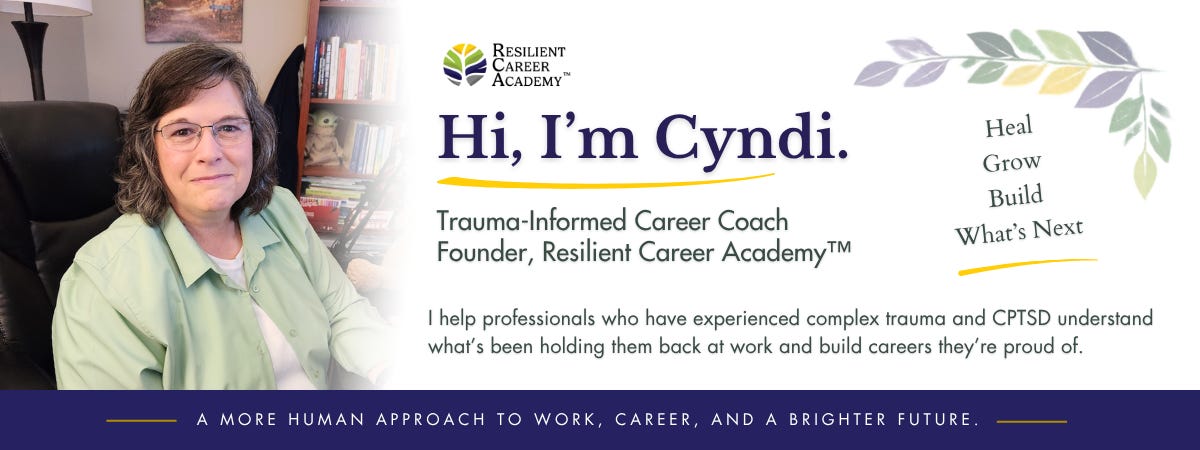
I’m also someone who spent a lot of my career trying to prove what I could do.
For a long time, I didn’t necessarily see that as a problem. Being determined to demonstrate my capability helped me develop skills, solve problems, navigate difficult situations, and build a career I’m proud of.
But as I began to understand how my own experiences with complex trauma had shaped the way I saw myself, I started questioning something I hadn’t really considered before.
Who was I trying so hard to convince?
And perhaps more importantly, why did I still need convincing after everything I’d already accomplished?
That’s what I invite you to explore with me today. How can beliefs we developed about ourselves long before entering the workforce influence our professional identity? Why might accomplishments fail to change those beliefs? And what might become possible if we could begin seeing ourselves through the evidence of who we’ve become rather than the beliefs we learned about ourselves long ago?
Want More Trauma-Informed Career Support?
If you’re navigating the ways complex trauma or CPTSD can affect your career, I invite you to subscribe to my Substack for free. You’ll get access to trauma-informed career development articles and resources designed to help you recognize patterns that may be holding you back, discover strengths you may not recognize in yourself, and explore new possibilities for building a career you’re proud of.
When We’re Trying to Prove Something to Ourselves
There’s nothing inherently wrong with wanting to demonstrate what we’re capable of.
When we’re learning something new, we don’t always know whether we can do it. We develop confidence through experience, practice, and discovering what happens when we try.
But for some of us who experienced complex trauma, the uncertainty can run deeper than whether we have the skills to accomplish a particular task.
We may have grown up with experiences that taught us to question our abilities, our judgment, our value, or whether we were good enough. Perhaps our accomplishments were overlooked, our mistakes were magnified, or the expectations placed on us seemed impossible to satisfy.
Those experiences can shape beliefs about ourselves that follow us into adulthood.
I’m not smart enough.
I’m not capable enough.
I’m not good enough.
And sometimes, without realizing it, we begin building careers around trying to overcome those beliefs.
We work hard. We figure things out. We take on challenges that stretch us beyond what we thought we could do. We earn credentials, develop expertise, receive recognition, and accomplish things that once seemed impossible.
Each accomplishment offers another piece of evidence that we are capable.
But something unexpected can happen.
We accumulate the evidence without changing what we believe about ourselves.
And so we keep trying.
When Accomplishment Doesn’t Change What We Believe
Have you ever accomplished something you weren’t sure you could do, only to find that the feeling of accomplishment didn’t last very long?
Maybe you earned the promotion you’d been working toward for years. You were excited, relieved, and proud of yourself. But before long, the questions started creeping back in.
What if I can’t handle this new role? What if they realize I’m not as capable as they think I am?
Or perhaps you completed a difficult project, received recognition for your work, and immediately started thinking about everything you could have done better.
Instead of allowing the accomplishment to become evidence of your capability, you found reasons to discount it.
That wasn’t really that difficult.
Anyone could have done that.
I just got lucky.
But can I do it again?
And before long, you’re looking for the next opportunity to prove yourself.
This is one of the more exhausting ways complex trauma can influence our careers.
We may be trying to use professional accomplishments to change beliefs about ourselves that were formed long before we ever entered the workplace.
The accomplishments are real. The skills we’ve developed are real. The career we’ve built is real.
But the beliefs we’re trying to overcome may not respond to evidence the way we expect them to.
We can spend years becoming more capable without ever feeling more capable.
And when that happens, the next accomplishment can start to feel like the one that will finally settle the question.
Maybe this time I’ll believe it.
When Proving Becomes Part of Our Professional Identity
Over time, that need to prove ourselves can become more than something we do. It can become part of who we believe we have to be.
We become the capable one. The dependable one. The one who figures things out. The person everyone turns to when there’s a problem because they know we’ll find a way to solve it.
And those qualities may be completely real.
We may be extraordinarily resourceful. We may learn quickly, notice things other people miss, solve complicated problems, or persist through situations that would have caused other people to give up.
Those are strengths we’ve developed, and they’re worth recognizing.
But there’s a difference between knowing we’re capable and needing to continually demonstrate our capability in order to believe it.
When our professional identity becomes intertwined with proving ourselves, ordinary workplace situations can begin carrying an additional emotional burden.
We’re not simply completing the project. We’re trying to convince ourselves that we’re capable of doing the work.
We’re not simply learning something new. We’re trying to overcome the fear that we aren’t smart enough to figure it out.
We’re not simply accepting an opportunity. We’re hoping it will finally make us feel like we deserve to be where we are.
And when we make a mistake, we may experience it as something much bigger than a mistake.
It can feel like evidence that the belief we’ve been trying so hard to overcome was right all along.
That’s an enormous amount of pressure to place on ourselves.
Let’s Recognize What Proving Has Given Us
I don’t think we need to turn our drive to prove ourselves into another behavior we’re supposed to feel bad about.
For many of us, that drive has taken us places.
Maybe someone underestimated us, and we figured out how to do something they didn’t believe we could do. Maybe we weren’t given the same opportunities as others, so we created our own. Maybe we entered a room without the experience everyone else seemed to have and taught ourselves what we needed to know.
Maybe the determination to prove that we could do something helped us develop expertise, resilience, resourcefulness, independence, persistence, or courage.
Some of us have careers we’re incredibly proud of because somewhere along the way, a little voice inside us said:
Watch me.
And we did.
We learned. We grew. We accomplished things. We developed strengths that became valuable parts of who we are professionally.
It’s important that we recognize those strengths rather than dismissing them simply because some of the motivation behind them may have come from painful experiences.
The strengths are still ours, regardless of what motivated us to develop them.
But we can also become curious about whether proving ourselves still needs to be the fuel that drives our careers.
Because the same determination that helped us build something meaningful can become exhausting when we believe we must keep accomplishing more just to feel that we’re enough.
What Happens When There’s Always Something Left to Prove?
When proving ourselves becomes automatic, we may stop noticing how often it influences our career decisions.
We might accept an impossible assignment because declining it feels like admitting we’re not capable. We might overprepare because walking into a meeting without every possible answer feels too risky. We might struggle to say, “I don’t know,” because somewhere inside us, not knowing feels like evidence that we’re inadequate.
We may have difficulty asking for help, even when help is readily available. We may interpret feedback as confirmation of our deepest doubts rather than information we can use to grow. We may continue carrying responsibilities long after we’ve established that we’re capable of carrying them.
And sometimes, we may pursue the next achievement without ever stopping to ask whether we actually want it.
That’s where this pattern can begin shaping the direction of our careers.
The question becomes less about what we want to accomplish and more about what we need to accomplish to finally feel capable.
We might pursue the promotion because it seems like proof that we’re good enough. We might accept the leadership role because turning it down feels like admitting we can’t do it. We might continue climbing a career ladder without ever considering whether the destination is somewhere we want to go.
And even when we reach the next milestone, the internal question may remain unresolved.
Am I enough yet?
If we’re constantly looking to the next accomplishment for an answer, we may spend years building careers that demonstrate our capability without giving ourselves permission to believe in it.
Being Capable Doesn’t Mean We Have to Pick It Up
One of the things I’ve been learning is that capability doesn’t automatically create obligation.
We can be capable of taking on another project and still decline it. We can know how to fix the problem and allow someone else to figure it out. We can have the answer and decide we don’t need to be the first person to provide it.
We can be qualified for an opportunity and decide it isn’t an opportunity we want.
And we can make a mistake without allowing that mistake to redefine everything we believe about ourselves.
For someone whose professional identity has been shaped by proving their capability, these choices may feel uncomfortable at first.
Because if we’ve been using accomplishment to reassure ourselves that we’re capable, choosing not to demonstrate our capability can leave us face-to-face with the very uncertainty we’ve been trying to overcome.
But what if we could begin approaching those moments with curiosity?
Instead of automatically accepting another responsibility, we might ask ourselves whether it’s something we genuinely want to take on.
Instead of treating a mistake as evidence of inadequacy, we might consider what we can learn from it.
Instead of assuming that asking for help means we aren’t capable, we might recognize that collaboration is also a professional skill.
And instead of pursuing the next accomplishment to prove something about ourselves, we might begin choosing opportunities because they’re meaningful to us.
Being capable of carrying something doesn’t mean we have to pick it up.
And perhaps we can begin trusting our capability without requiring ourselves to demonstrate it at every opportunity.
So Who Am I If I’m Not Proving Myself?
This may be the harder question.
Because if we’ve spent years building our professional identity around overcoming the belief that we’re not enough, changing that pattern isn’t simply about working less or setting better boundaries.
It can challenge the way we’ve learned to understand ourselves.
If I’m not the one who always figures it out, who am I?
If I’m not constantly accomplishing something, how do I know I’m making progress?
If I stop pushing myself to do more, will I still believe I’m capable?
And if my accomplishments have been one of the primary ways I’ve tried to convince myself that I’m enough, what happens when I stop asking them to do that job?
There’s an opportunity here to explore a different relationship with our professional identity.
What if we could recognize our resourcefulness without needing another crisis to demonstrate it?
What if we could appreciate our expertise while accepting that there will always be things we don’t know?
What if we could acknowledge how far we’ve come without immediately turning our attention to how much farther we still need to go?
We might discover that we’re still capable, ambitious, resourceful, determined, and curious.
But those qualities can become strengths we recognize in ourselves rather than roles we feel obligated to perform.
And perhaps we can begin separating two ideas that have become intertwined.
Our competence is something we can develop, strengthen, and expand throughout our careers. There will always be things we know how to do and things we haven’t learned yet.
Our worth, however, isn’t determined by how competent we are.
We don’t become more worthy when we accomplish something, and we don’t become less worthy when we struggle.
That’s an important distinction when we’ve spent years trying to use accomplishment to answer questions about our value.
What Might Become Possible If We Believed the Evidence?
I invite you to consider something.
What if you could look at your career and recognize what you’ve already demonstrated about yourself?
Not as a way to convince yourself that you’ll never struggle again, make another mistake, or encounter something you don’t know how to do.
But as an opportunity to recognize that you’ve learned, adapted, grown, and developed capabilities you may not be giving yourself credit for.
And what if you could begin making career decisions from that understanding?
Instead of asking whether you can prove that you’re capable of taking on a new challenge, you might ask whether it’s a challenge you want.
Instead of automatically pursuing the next promotion, you might consider what success means to you at this stage of your life.
Instead of measuring your professional identity by how much you can accomplish, you might begin considering the kind of work you enjoy, the strengths you want to use, the contributions you want to make, and the life you want your career to support.
Maybe the next stage of your career isn’t about becoming more capable.
Maybe it’s about beginning to recognize the capability you’ve already developed and deciding what you want to do with it.
A Few Questions to Explore
I invite you to spend some time with these questions. There’s no right answer, and you don’t have to figure everything out today.
What have I spent my career trying to prove to myself?
What evidence of my capability have I accumulated that I may not be allowing myself to recognize?
What strengths did I develop along the way that I genuinely want to keep?
If I no longer needed my career to prove that I’m enough, what would I want my career to be about instead?
That last question may take some time to explore, especially if proving ourselves has influenced our decisions for much of our careers.
But I think it’s a question worth asking.
Because when we begin separating our worth from our accomplishments, we may discover that our careers can become something more than a place where we continually try to overcome what we believe is wrong with us.
They can become a place where we choose what we want to build.
Exploring Your Professional Identity in a Supportive Environment
If this article has you wondering how much of your professional identity has been shaped by what you’ve needed to prove to yourself, you don’t have to explore those questions alone.
In 1:1 trauma-informed career coaching, we can create a supportive environment to explore how your experiences may have influenced the way you see yourself professionally, the strengths you’ve developed, the patterns that may be affecting your career decisions, and what you want to carry forward.
We can examine the difference between the professional identity you’ve built and the one you want to build moving forward, with space for curiosity, reflection, and choice.
The goal isn’t for me to tell you who you should be or what your career should look like. It’s to support you in discovering what matters to you and identifying the possibilities you want to pursue.
Maybe We’ve Been Riding on Our Own for a While
I keep coming back to that bicycle.
The child who was so confident riding with training wheels, but suddenly wasn’t sure they could do it when the training wheels came off.
The child who could balance and steer once the bike was moving, but wasn’t yet confident enough to get started without someone giving them that first push.
And then that moment when they looked back and realized the person they thought was holding onto the seat had already let go.
They’d been balancing. They’d been steering. They’d been making all those tiny adjustments that kept the bike moving forward.
They’d been riding on their own.
But they didn’t know it yet.
And there’s another part of that experience worth remembering.
Learning that we can ride once we’re moving doesn’t automatically mean we’ve learned how to start without help.
That can take more practice, and needing that practice doesn’t erase the capability we’ve already developed.
I wonder how many of us have spent years building careers that demonstrate our capability while still seeing ourselves through the eyes of the person who wasn’t sure they could ride.
Maybe we’ve been gathering evidence for years. Maybe we’ve accomplished things we once couldn’t imagine doing, and maybe there are still some things we’re learning how to do.
We can recognize how capable we’ve become without requiring ourselves to have mastered everything.
And perhaps the next stage of our careers doesn’t require another accomplishment to prove that we’re enough.
Maybe it begins with recognizing what we’ve already demonstrated, trusting ourselves to learn what we haven’t yet mastered, and asking a different question.
The bit about accumulating evidence without it changing the verdict is the real crux here. More proof rarely closes a case that was never really about proof.
A practical test might be noticing the next yes you give automatically, the one that arrives before you have asked whether you actually want the thing. That is usually the old pattern working, not a genuine choice.