


Have you ever taken a road trip where you were so focused on getting to your destination that you barely noticed anything along the way?
You had your route planned and knew when you wanted to arrive. Every stop felt like a delay. But perhaps you passed a beautiful view, an interesting little town, or a sign pointing toward something you'd always wanted to explore.
Eventually you arrived, put the car in park, and finally had room to look around.
You'd made it where you were going. Now, what did you want to explore?
Perhaps you’ve reached a similar point in your career.
You’ve worked hard to build experience, earn a dependable income, and establish yourself. You may be good at your work and grateful for what it provides. Yet when you ask whether this is the work or life you want, the answer isn’t clear.
You know how to do what’s expected of you. You may have had much less practice noticing what you want.
And when something does spark your interest, you might quickly question it. Is wanting more ungrateful? Would exploring something different put your stability at risk? After everything it took to get here, shouldn’t you just be satisfied?
That uncertainty can leave you continuing along a familiar path without knowing whether it still fits.
I’ve been thinking about how much of my early career felt like that road trip, and what changed when I finally had room to ask where I wanted to go next.
When Getting There Takes Everything We've Got
For much of my early career, I was focused on proving that I belonged in my company, deserved my position, and had the potential to advance. But the person I was working hardest to convince was myself.
There was a lot of self-doubt beneath the surface. I questioned whether I was capable enough, whether I deserved the opportunities I'd been given, and whether I had what it took to keep advancing.
I invested an enormous amount of energy trying to overcome those feelings. I worked hard, took on challenging assignments, developed my skills, and built a reputation as someone who could get things done.
And those efforts mattered. I was building genuine capability, experience, and financial security.
By the middle of my career, I'd accumulated a work history and accomplishments I could look back on. My salary and title reflected the value I brought to the organization. I could finally recognize the evidence of my own capability, rather than feeling I had to keep hustling to earn recognition or compensation.
It was almost as though a fog had lifted.
I hadn't suddenly become capable. I'd been capable and developing my skills all along. What had changed was my ability to recognize what I'd built, and to imagine what I might want to explore next.
Before We Go Further, Let Me Introduce Myself
I'm Cyndi Bennett, a trauma-informed career coach and Founder of the Resilient Career Academy.
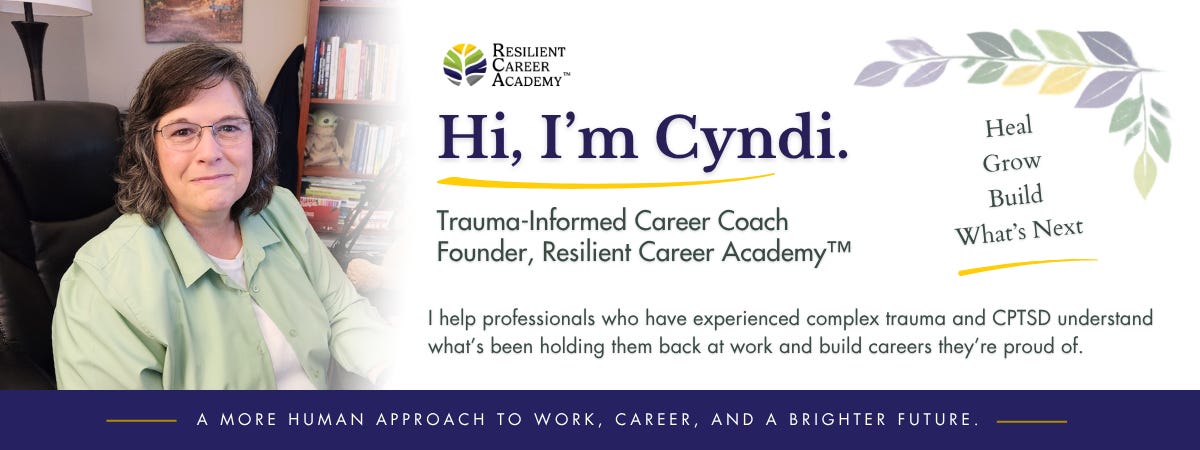
I help survivors of complex trauma and CPTSD recognize the patterns that may be holding them back, rediscover the strengths and capabilities they bring to the workplace, and build careers based on their own vision of success rather than the limitations trauma taught them to believe in.
Today, we're exploring three ideas about how survival can shape career goals, why our sense of possibility may lag behind our accomplishments, and how we can define success in ways that honor both our needs and our aspirations.
Survival Can Shape How We Define Career Success
When I look back, I don't think I was wrong to focus on establishing myself. I needed financial security, professional experience, and opportunities to support myself and build a stable future. Those were real needs, not beliefs I should have simply outgrown.
For many of us who have experienced complex trauma, a dependable paycheck can mean independence. Benefits can mean access to healthcare. Predictability can mean a measure of security that wasn't always available earlier in life.
But survival can influence more than the goals we pursue. It can shape how we measure success.
We may begin to associate success with being indispensable, receiving approval, earning the next promotion, or showing that we can handle whatever comes our way. Those motivations can help us develop meaningful strengths. They can also make it difficult to recognize when we've already demonstrated enough.
Imagine someone who has become exceptionally skilled at solving problems and carrying a heavy workload. When an opportunity arises to do work they would genuinely enjoy, they hesitate. What if they aren't immediately the person everyone depends on? What if they have to be a beginner again?
The hesitation may not be about ability. It may be about what they've learned to use as evidence of their value.
Are the goals we're pursuing still connected to what we want, or have they become ways of reassuring ourselves that we're safe, capable, and worthy?
There's nothing wrong with valuing security, advancement, or recognition. The question is whether those are the only measures we're allowing ourselves to consider.
What Do I Want My Work to Make Possible?
When we’ve spent years focused on becoming secure and establishing ourselves, we may have had little room to consider what else we want from our work. Even when that room begins to open up, our own preferences can be difficult to recognize.
I invite you to take a moment to consider the question below. It can help you begin identifying what you want your career to support at this stage of your life. You don’t need a complete vision for the future. Naming one thing you’d like more room for is enough to start.
What do I want my work to make possible, beyond helping me get through the week?
Notice that this isn't asking for your next job title. It invites us to think about the life and experiences we want our careers to support.
Perhaps you want financial freedom, flexibility, meaningful contribution, more opportunity to use your strengths, or enough energy to enjoy your life outside work. Maybe you want leadership, a new area of expertise, or the chance to explore an interest you've put aside.
There isn't one right answer, and yours may change over time. This isn't a prompt to abandon stability or make a risky career move. It's an invitation to notice that our careers can help us create more of what we want, not only protect us from what might go wrong.
From Recognition to Possibility
When we begin asking what we want, other questions may appear:
Can I afford to want that?
Am I qualified?
What if I lose the stability I've worked so hard to build?
Those concerns deserve attention. And they bring us to the next part of our deep dive: our circumstances may have changed since we developed some of the beliefs guiding our career decisions.
Paid members can continue with two more teaching points and The Beyond-Survival Career Reflection, a printable companion worksheet for recognizing what we've built, assessing real constraints, and exploring one manageable next step.
If you are ready to move from understanding what you are feeling to knowing what to do about it, the rest of this article is waiting for you inside The Resilient Career Academy. I would love to have you there.
