


Have you ever set out on a hike that seemed simple enough?
You pick a trailhead, glance at the map, and decide to do the loop around the lake. Nothing too ambitious. Just some fresh air, a little movement, and time to clear your head.
At first, you settle into it. You hear your footsteps on the dirt, catch glimpses of water through the trees, and feel your shoulders begin to loosen.
Then you come to a fork in the path.
There’s a sign, but it’s weathered and hard to read. Both trails look well-traveled. One seems to follow the lake, but the other could curve back toward it just beyond the trees.
You look behind you, then down each path. Was there something on the map I missed?
A few minutes ago, you were enjoying yourself. Now you’re wondering whether you can trust your own sense of direction.
You don’t want to turn back. But you don’t want to spend the next hour walking the wrong way, either.
That uneasy feeling can show up in your career, too. You might find yourself looking for the choice that feels safest before you’ve had a chance to consider where you want to go.
And you may not recognize how much your early experiences have shaped which paths feel safe enough to consider.
In this article, we’ll explore how childhood trauma can influence the career choices you make, why those patterns can be difficult to recognize, and what understanding them can make possible.
The Map You Learned to Follow
At a confusing fork in the trail, your first concern may be whether you can get back safely. You check the map, look for markers, and try to work out which route you can trust.
When you grow up experiencing childhood trauma, the search for safety can become a pattern that shapes your life without your awareness.
You may never consciously ask, What do I need to do to be safe here? Yet that question can quietly influence what you notice, what feels possible, and which choices you make.
As a child, you may have learned to read someone’s mood before speaking. To be useful, so you were less likely to be criticized. To get everything right because mistakes brought consequences. Or to keep your wishes to yourself because expressing them could lead to conflict.
You may have learned to make yourself small so your confidence, abilities, or independence wouldn’t be perceived as a threat by the person in power. You may have learned to stay invisible because being overlooked felt safer than being noticed.
At work, those lessons can make visibility feel risky. You might downplay an accomplishment, hold back an idea, or avoid a promotion that would put you in the spotlight. You may want recognition and still feel an urge to hide when attention turns toward you.
With repetition, those responses can become automatic. You may carry them into adulthood without recognizing where they began.
When you make career decisions, you might experience them as being practical, responsible, or realistic. You may feel certain that an opportunity “isn’t for someone like me” without noticing the fear of criticism or rejection beneath that certainty.
That’s part of what makes these patterns difficult to recognize. You’re making a decision that feels sensible, while an old need for safety may be helping determine which options you allow yourself to consider.
A job with clear expectations might feel reassuring because you know exactly how to avoid getting something wrong. Being indispensable might feel like protection against being let go. Staying quiet about your ambitions might seem safer than risking someone’s judgment.
You might choose work you know you can do rather than work you’re curious about. You might stay with an unpredictable boss because you’ve become skilled at anticipating what they need. Or you might dismiss an opportunity before you’ve had time to consider whether you want it.
From the outside, these can look like straightforward career preferences. Inside, the stakes may feel much higher.
Will I be accepted? Can I keep everyone happy? What happens if I fail?
Safety belongs in every career decision. Income, stability, benefits, and respectful working conditions matter. But when avoiding criticism, conflict, or rejection takes up most of your attention, there may be little room left to ask what interests you or what kind of working life you want.
That can be painful to recognize, especially if you’ve worked hard to build a career that looks successful.
You don’t have to judge yourself for the choices you’ve made. You can begin by asking:
How much of this path have I chosen because it suits me, and how much have I chosen because it felt like the safest way forward?
Before We Go Further, Let Me Introduce Myself
I’m Cyndi Bennett, a trauma-informed career coach and Founder of the Resilient Career Academy.
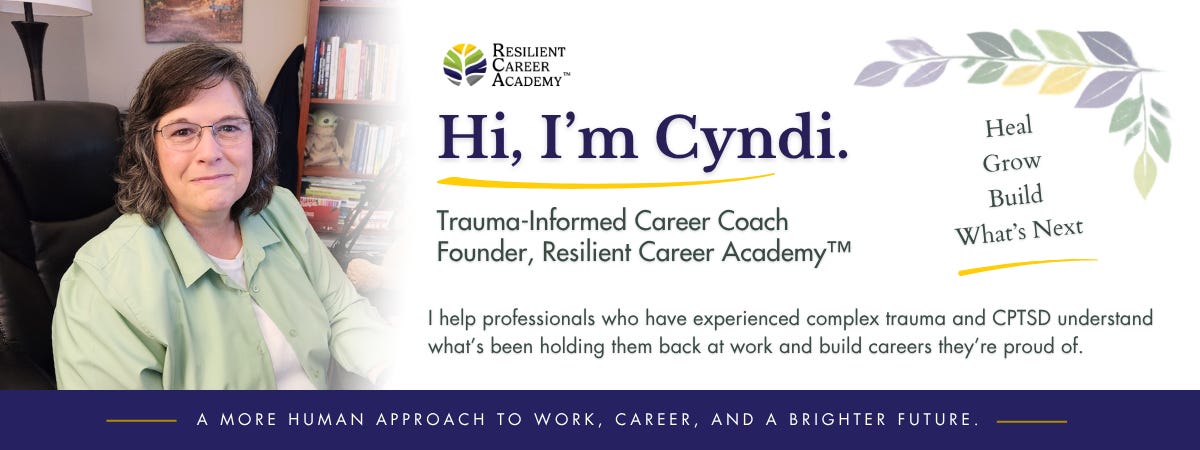
I help professionals who have experienced complex trauma and CPTSD understand what’s holding them back at work and build careers they’re proud of.
Sometimes that work begins with a question that’s hard to say out loud:
How much of my career have I chosen around what I want, and how much around what I’ve needed to do to feel safe?
You may have become indispensable. You may have learned to keep your abilities out of sight. You might have spent so long responding to what other people expected that you’re unsure what you would choose for yourself.
That’s what we’re exploring here: how early experiences can influence the work you choose, the opportunities you pursue, and what you believe is possible for your future.
When Being Good at Something Keeps You Stuck
You’re looking at a job posting, and for a moment, you feel excited.
The work sounds interesting. You have ideas already. You can almost picture yourself doing it.
Then you imagine being interviewed. Being evaluated. Being expected to prove that you belong.
Within minutes, you’ve closed the tab.
Later that day, someone asks you to take on another task in your current job. You’re already stretched thin, but you hear yourself say, “Of course.”
The opportunity you wanted felt risky. The extra work you didn’t want felt difficult to refuse.
If being useful once helped protect you from criticism or rejection, you may feel more secure when other people need you. You become the person who fixes things, fills the gaps, and rarely asks for anything in return.
Your abilities are real. So is the exhaustion of feeling that you must keep demonstrating your value.
For someone else, safety may have meant hiding those abilities.
Perhaps doing well attracted resentment, scrutiny, or demands you couldn’t escape. You learned to let someone else take the credit, keep your ideas to yourself, or act as though an achievement didn’t matter.
Now you might want a promotion and still feel relief when nobody suggests you for it. You might feel hurt when your contribution goes unnoticed, then uncomfortable when someone praises you publicly.
That push-and-pull can be confusing. It can leave you wondering why you keep stepping away from things you thought you wanted.
You don’t have to assume that every hesitation is an old protective response. A promotion may bring responsibilities you don’t want. Extra work may genuinely interest you. The question is whether you feel able to consider your preferences alongside the possible consequences.
Am I free to say no when I’m capable of helping? Am I free to be seen when I have something to contribute?
When You Haven’t Had Room to Discover Who You Are
“What do you want to be when you grow up?”
For some children, that question opens up possibilities. They get to imagine, experiment, change their minds, and discover what interests them.
For a child experiencing trauma, attention may be focused on a different set of questions.
What mood is everyone in today?
What do I need to do to keep things calm?
Is it safe to ask for something?
When so much attention goes toward getting through the day, there may be little room left to explore preferences, try unfamiliar activities, or imagine a future.
You may also learn to hide the things you enjoy or do well. An interest becomes something you keep private. An ability becomes something you downplay. Eventually, you may struggle to recognize either as something worth pursuing.
Years later, someone asks what you want from your career, and you don’t know how to answer.
You can describe what an employer needs. You know how to adapt. But knowing what interests you, what you’re good at, or who you want to become can feel much less certain.
How can I have worked this hard for this long and still not know what I want?
That question can carry grief. Perhaps you watch other people describe their ambitions with a confidence you wish you felt. Perhaps advice about “following your passion” leaves you feeling further behind.
You don’t have to produce a hidden passion or a childhood dream to move forward. Some interests may become clearer as you give them attention. Others may develop through experiences you haven’t had yet.
You can try something without deciding whether it should become your career. Notice what holds your attention. Give yourself permission to be a beginner and to change your mind.
You deserved opportunities to discover yourself then. You deserve those opportunities now, too.
Understanding the Pattern Is Only the Beginning
Recognizing yourself in these patterns can bring relief. There may be an explanation for choices you’ve questioned or reactions you’ve struggled to understand.
It can also leave you asking, If I can see what I’m doing, why can’t I stop?
A response you learned through years of trying to stay safe may continue to feel necessary even after you recognize it. You might understand that you downplay your abilities and still feel exposed when someone praises your work. You might know that you’re overcommitted and still fear that disappointing someone will threaten the connection.
Understanding what shaped those responses matters. It helps you separate what you learned to expect in the past from what is happening in the present.
The present may still contain real risks. A workplace can be unpredictable, demanding, or unkind. Your need for income and stability deserves respect. Understanding your history can help you see how those current realities and earlier experiences may both be influencing your decisions.
Awareness is a beginning. Changing a familiar response takes further work, and knowing that can ease the frustration of expecting yourself to behave differently simply because you understand the pattern.
You don’t have to turn that understanding into an immediate career decision. You can acknowledge what you’re discovering and recognize that there is work you can do, with support, to develop more choice.
Your Career Can Have More Room for You
You may have come to this article wondering why you keep choosing work that exhausts you, stepping away from opportunities, or struggling to know what you want.
Looking at those choices through the lens of childhood trauma can help them make sense. Being needed may have helped you preserve connection. Staying invisible may have protected you. Choosing the familiar may have reduced uncertainty when you had little room to take risks.
Those responses developed in the circumstances you were navigating. They don’t have to determine every choice ahead of you.
Change might mean being able to acknowledge your abilities without immediately minimizing them. Considering an opportunity before ruling yourself out. Or making a decision that respects your limits without feeling that your connection to someone depends on saying yes.
It may also mean discovering interests you haven’t had room to explore and beginning to imagine a working life that includes more of who you are.
This is the work the 5 R Framework supports: Recognize, Root Out, Rebuild, Rehearse, and Reinforce. It’s the framework I teach in the Resilient Career Academy to help you move beyond recognizing a pattern and learn how to work on changing it.
Back at the fork in the trail, you may still need information, time, or support. But you can begin to understand what is influencing your direction and make room for what you want from the journey, too.
If you recognize these patterns and want support learning how to change them, consider joining the Resilient Career Academy. You’ll find guidance in applying the 5 R Framework, support as you learn, and a community that understands how past trauma can show up in your career today.
You don’t need a clear career goal or all the answers before you join. Recognizing that you want something to change is a place to begin.
Join us in the Resilient Career Academy. We can work on what comes next, together.
Know someone who might recognize themselves in these words? Please share this article with them. It may help them make sense of their own career experiences and feel a little less alone.