


Do You Remember Darth Vader?
From the moment Darth Vader appears in Star Wars, there is no question that he is someone to be reckoned with.
He doesn’t have to announce his power. You can feel it.
The black helmet. The cape. The mechanical breathing that lets you know he’s coming before he even enters the room.
He is intimidating. Commanding. Driven. Powerful.
He walks into a room and people respond.
He doesn’t appear uncertain. He doesn’t appear overwhelmed. He certainly doesn’t look like someone who needs help.
He is strong in the dark side of the Force, capable of taking control of a situation without ever raising his voice, and seemingly unfazed by whatever stands in his way.
For most of the original Star Wars trilogy, that’s the Darth Vader we know.
Powerful.
In control.
A force to be reckoned with.
And then, near the end of Return of the Jedi, something happens that changes the way we see him.
Luke removes his father’s mask.
For the first time, all of that armor is stripped away.
And the man underneath looks nothing like the figure we’ve been watching.
He is pale. Scarred. Frail.
He is dying.
Suddenly, there is this enormous contrast between the person everyone else could see and the person who had been underneath the armor all along.
The armor hadn’t just protected him.
It had hidden how vulnerable the person underneath it really was.
We may not walk into work wearing a black helmet and cape, but many of us have learned to wear armor of our own. Armor that helps us look strong, confident, and in control, even when something very different may be happening underneath.
And for some of us, part of that armor is being the capable one.
The person who can handle it.
The person who figures it out.
The person everyone can count on.
The person who never seems to need much from anyone else.
And sometimes our armor can be so convincing that no one thinks to ask what it takes to keep wearing it.
If We Haven’t Met Yet
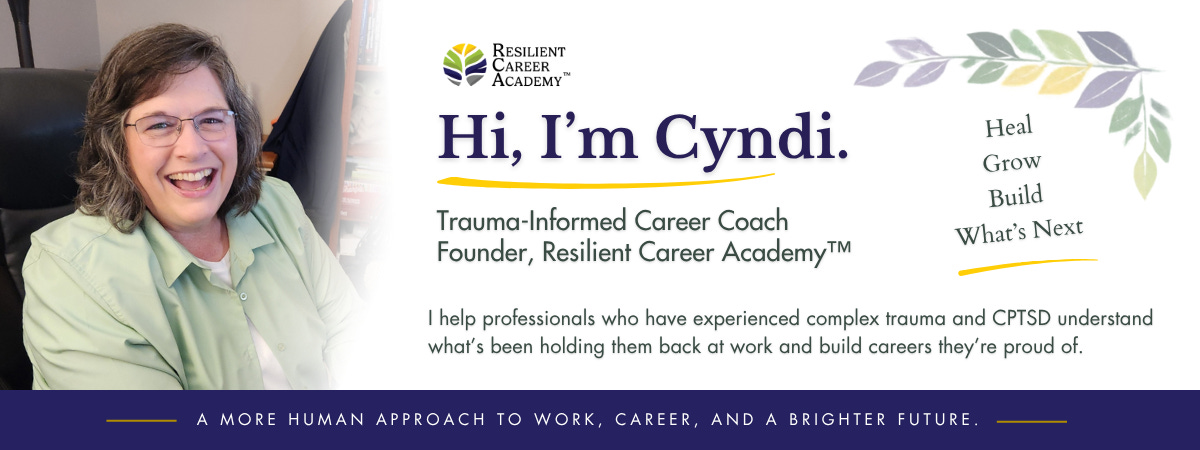
If we haven’t met yet, I’m Cyndi Bennett, a trauma-informed career coach and founder of the Resilient Career Academy. You’re listening to or reading Issue #10 of The Resilient Career Academy Newsletter, where we explore how the after-effects of complex trauma can show up in our careers and what becomes possible when we begin recognizing the patterns they can create.
Today, I want to talk about one piece of armor I know well: being the capable one.
Because being capable can be a tremendous strength. It can help us build successful careers, earn the trust of the people around us, and open doors to opportunities we worked incredibly hard for.
But what happens when being capable becomes more than something we know we are?
What happens when it becomes someone we believe we have to be?
“I Can Handle It.”
I can’t tell you how many times I’ve said some version of those words throughout my career.
And most of the time, they were true.
I could handle it. I could figure things out. I could walk into complicated situations, make sense of what was happening, and find a way forward. Give me something I’d never done before, and I’d learn. Give me a problem no one knew how to solve, and I’d start looking for answers.
That capability has served me incredibly well throughout my career.
It helped me become someone people trusted. I was given more responsibility because people knew I would follow through. I was invited into bigger conversations and given increasingly complicated problems to solve.
And every time I handled the next thing, I reinforced something for the people around me and for myself:
Cyndi can handle it.
That’s where this gets complicated.
Because there is a difference between knowing we’re capable of handling difficult things and believing we have to handle everything ourselves.
For a long time, I’m not sure I recognized the difference.
Being capable wasn’t the problem. My capability was real, and I’m proud of what it helped me accomplish.
But somewhere along the way, “I can handle it” became part of the armor.
It meant I could keep functioning without anyone knowing how much effort it was taking. I could solve the problem instead of admitting I didn’t know what to do. I could take on one more thing rather than acknowledge that I was already carrying too much.
And because I kept handling it, the people around me had very little reason to believe I couldn’t.
They could only respond to the version of me I was allowing them to see.
When Being Capable Feels Safer
For some of us, being capable became valuable long before we ever entered the workplace.
Maybe we learned that the safest person to depend on was ourselves. Maybe asking for help didn’t always result in help. Maybe we learned to anticipate what needed to happen before anyone had to ask, or discovered that being responsible, independent, and easy to take care of earned us approval.
We may not have consciously decided, I’m going to become the person who never needs anything from anyone.
We adapted.
We figured things out. We learned how to solve our own problems. We became resourceful. We learned how to keep functioning when things around us weren’t functioning particularly well.
And then we entered the workplace, where many of those adaptations were rewarded.
The employee who doesn’t need much direction can be seen as a self-starter. The person who always finds a solution becomes the problem-solver. The one who takes responsibility when something goes wrong becomes dependable. The person who can carry an enormous workload becomes the person everyone turns to when there is more work to be done.
The workplace may have had no idea what it took for us to become that person.
It just knew that we delivered.
And every promotion, compliment, difficult assignment, and “Give it to Cyndi, she’ll figure it out” could reinforce something we’d already learned:
Being capable works.
It helps us feel in control. It reduces the need to depend on other people. It can protect us from the vulnerability of admitting we don’t know, can’t do something, or need support.
And it may help us build a pretty successful career.
That’s why I don’t think the answer is to stop being capable.
The question is whether we still have a choice about when we put the armor on.
Because there’s a significant difference between:
I can figure this out myself.
and
I can’t let anyone see that I need help figuring this out.
Between:
I can carry this.
and
I can’t let anyone know this is too heavy.
Between:
I’m capable.
and
I have to be the capable one.
And when that last one starts driving us, the armor that helped us succeed can also make it incredibly difficult for anyone to see when we’re struggling underneath it.
What Happens When Everyone Believes the Armor?
There is an interesting consequence to becoming the person who can always handle it.
People start believing us.
If we consistently show the people around us that we can figure things out, carry the extra load, solve the problem, and keep going no matter what is happening, eventually they stop wondering whether we need help.
Why wouldn’t they?
We’ve given them every reason to believe we’re fine.
They may not see how much energy it takes to keep everything moving. They don’t know how long we stared at the computer trying to make our brain cooperate. They don’t see the anxiety before the meeting, the tears after we log off, or how little of ourselves may be left by the time we get home.
They see the work getting done.
They see capable.
And this is where the armor can become incredibly isolating.
We may desperately want someone to notice that we’re struggling while simultaneously doing everything we can to make sure they don’t.
We may wish someone would offer to take something off our plate while continuing to reassure everyone that we’ve got it.
We may feel hurt that nobody checks on us while presenting ourselves as the person nobody ever needs to check on.
That’s a painful contradiction.
And I don’t think it means the people around us are necessarily uncaring. They may simply be responding to what we’ve shown them.
Our armor is doing exactly what we designed it to do.
It’s protecting the parts of us we don’t feel safe enough to show.
But protection can come with a cost.
If no one can see that we’re struggling, they can’t respond to the struggle they can’t see. If no one knows we need support, they don’t have the opportunity to offer it. And if we’ve built our professional identity around being the person who can handle anything, taking off even one piece of that armor can feel incredibly vulnerable.
Because then we’re faced with a different question:
What happens if they see that I can’t handle everything?
And maybe an even harder one:
Will they still see me as capable when they see that I’m human?
What If Both Can Be True?
Somewhere along the way, many of us may have created a choice that was never really ours to make.
Either I’m capable, or I need help.
Either I’m strong, or I’m struggling.
Either I know what I’m doing, or I’m in over my head.
Either I can handle it, or I can’t.
But what if those things were never opposites?
We can be incredibly capable and still reach the edge of our capacity. We can be resourceful and still benefit from someone else’s expertise. We can know what we’re doing and still have moments when we don’t know what to do next. We can be strong and still need someone to stand beside us while we navigate something hard.
Needing support doesn’t erase our capability.
That has been an important shift for me.
Taking off the armor doesn’t require me to hand over everything I’ve learned to do for myself. It doesn’t mean I suddenly become dependent on everyone around me or stop trusting my own ability to figure things out.
Maybe it means I no longer have to prove my capability by how little I need from anyone else.
I can ask the question instead of spending three hours finding the answer myself. I can tell someone I’m at capacity before I reach my breaking point. I can let a trusted colleague know that something affected me. I can accept an offer of help without immediately trying to convince them, and myself, that I’ve got it.
And perhaps most importantly, I can allow someone to see that I’m struggling without deciding that what they’re seeing is weakness.
Because the goal isn’t to stop being the capable one.
It’s to know that we don’t have to wear capability as armor in order for it to be true.
Maybe We Don’t Have to Wear the Armor All the Time
When Luke removed Darth Vader’s mask, the person underneath hadn’t suddenly become weak.
He had been underneath the armor the entire time.
And maybe that’s worth remembering when we think about our own armor at work.
Letting someone see that we’re struggling doesn’t erase decades of competence. Asking for help doesn’t undo everything we’ve accomplished. Saying “I don’t know” doesn’t take away what we do know. Reaching the edge of our capacity doesn’t mean we were never capable in the first place.
The capability is still there, even when the armor isn’t.
And maybe healing isn’t about ripping off the armor and deciding we’re never going to wear it again.
That armor may have protected us for very good reasons. There may still be people, situations, and workplaces where we decide that keeping parts of ourselves protected is exactly what we need to do.
But perhaps we can begin noticing when we’re wearing it automatically.
We can ask ourselves whether we actually need it right now.
Whether the person standing in front of us has earned enough trust to see a little more of what’s underneath.
Whether “I can handle it” is something we’re choosing because we genuinely want to handle it, or something we feel compelled to say because we don’t know who we’d be if we couldn’t.
We don’t have to stop being strong.
We don’t have to stop being resourceful.
And we certainly don’t have to stop being capable.
Maybe we can simply begin giving ourselves permission to be capable without having to look invulnerable.
What Might Change If You Didn’t Have to Carry It All Alone?
Recognizing our armor is one thing. Figuring out when we still need it, what might feel safe enough to do differently, and how those patterns are shaping our careers can be much harder to navigate on our own.
That’s the kind of work I do through trauma-informed career coaching.
We can look at the patterns showing up in your career, understand what they may be protecting, and explore what could become possible if you had more choice in how you respond, without asking you to give up the strengths that helped you get this far.
Such a great way of looking at the one who handles it and what can really be happening underneath.
Appreciate this one, Cyndi!
the Darth Vader setup lands because competence-as-armor is invisible from the outside — everyone sees the capability, nobody sees what's holding it together. the first crack often isn't failure, it's finally having a moment quiet enough to feel the weight.