When was the last time you thought about what kind of work jazzes you?
Not what you’re qualified to do.
Not what someone would hire you to do.
Not what you’ve already spent 10, 15, or 20 years doing.
I’m talking about the kind of work that makes something in you come alive.
The problem you can’t resist trying to solve. The conversation you could have for hours. The thing someone asks for your help with and, instead of feeling drained afterward, you find yourself thinking about three more things you could have told them.
That kind of jazzed.
Somewhere along the way, many of us learned to think about our careers from the opposite direction.
What can I do?
What am I qualified for?
What’s available?
What will pay enough?
What feels safe?
Those are important questions. We have bills to pay and responsibilities to consider. There are practical realities involved in almost every career decision we make.
But what if those aren’t the only questions we get to ask?
Before We Go Any Further, Let Me Introduce Myself
I’m Cyndi Bennett, a trauma-informed career coach and the founder of the Resilient Career Academy™.
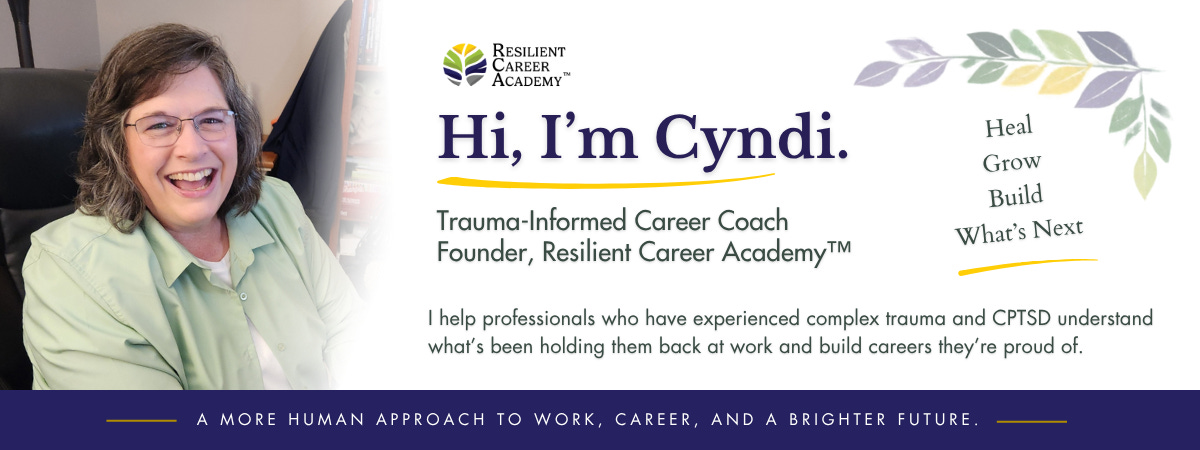
I spent more than two decades building my own corporate career before I began to understand how much our lived experiences can shape the way we navigate work.
Today, I help trauma survivors explore what can become possible in their careers when we begin recognizing the patterns that may have been limiting our choices and start building careers around more than survival.
And one of the things I believe deeply is this:
Every person is uniquely equipped by the Creator with gifts and talents specific to them, and our lived experiences can deepen and enhance those abilities.
That’s what I want to explore with you today.
We’re going to look beyond job titles and résumés and begin looking for the clues that can help us identify our unique equipping: our gifts, talents, interests, lived experience, curiosity, and the things that make us come alive.
Because maybe the question isn’t simply:
What job should I do next?
Maybe there’s another question worth asking first:
What have I been uniquely equipped to contribute?
We Don’t Have to Start With a Job Title
Think about the way we typically approach career exploration.
We pull up a job board.
We search for titles similar to the one we already have.
We read the qualifications and start sorting opportunities into two categories:
I could do that.
I couldn’t do that.
And before long, the possibilities for our future have been narrowed by our past.
We’re looking for the next version of something we’ve already done.
But a résumé tells us where we’ve been. It doesn’t necessarily tell us everything we’re capable of becoming.
That’s why I like starting somewhere else.
I believe every person is uniquely equipped by the Creator with gifts and talents specific to them, and that our lived experiences can deepen and enhance those abilities.
Our unique equipping is bigger than a list of skills.
It’s the combination of the things that seem to have always been there and everything life has added along the way.
Our natural gifts.
Our talents.
Our interests and curiosities.
The way our minds work.
The things we’ve learned.
The experiences we’ve had.
The problems we’ve solved.
The perspectives we’ve developed.
The skills we’ve practiced until they’ve become second nature.
Put all of those things together, and the combination is uniquely ours.
So instead of beginning career exploration with:
What job should I do next?
I think there’s another question worth asking first:
What have I been uniquely equipped to contribute?
Our Lived Experience Can Change How We Use Our Gifts
I want to be careful here, especially when we’re talking about trauma.
I don’t believe we need to call what happened to us a gift.
We don’t have to be grateful for painful experiences or believe we needed them in order to become valuable.
Our gifts don’t have to come from our trauma for our lived experiences to influence how we’ve learned to use them.
Maybe you’ve always had a gift for recognizing patterns.
Life may have sharpened your ability to notice things other people miss.
Maybe you’ve always been a communicator.
The experiences you’ve navigated may have taught you how to explain complicated things in ways people can understand.
Maybe you’ve always been deeply curious.
The problems you’ve encountered may have given that curiosity somewhere meaningful to go.
Maybe you’re naturally good at bringing order to chaos, connecting people, creating something from nothing, seeing possibilities, teaching, organizing, advocating, analyzing, building, designing, listening, leading, or solving problems.
Then life happens.
We work. We learn. We struggle. We succeed. We make mistakes. We recover. We change directions. We encounter people and situations that teach us things we never would have learned in a classroom.
Our lived experience becomes another layer of our equipping.
And that creates a career question I find much more interesting than “What am I qualified to do?”
Where could I use this unique combination of gifts, talents, abilities, interests, and lived experience in a way that jazzes me?
But What If I Don’t Think I Have Any Special Gifts?
Maybe you read all of that and thought:
That’s a nice idea, Cyndi.
I’m just not sure it applies to me.
I think we need to talk about that.
Because some of us may genuinely struggle to believe we’re uniquely equipped at all.
When someone asks what we’re good at, our mind goes blank.
We can identify talent in everyone around us, but when the attention turns toward us, suddenly we can’t think of anything.
Or the things we’re good at seem so ordinary that we don’t count them.
Anybody can do that.
That’s not really a skill.
It’s easy.
It’s not anything special.
But here’s something worth considering:
Maybe it feels easy because it’s one of your gifts.
We’re experiencing our abilities from the inside. We don’t necessarily know what it’s like for someone who doesn’t think the way we think or see what we see.
And for some trauma survivors, there may be another layer.
We may have spent years becoming experts at identifying what was wrong with us.
What needed fixing.
Where we weren’t enough.
What we needed to do better.
How we needed to change to be accepted, valued, successful, safe, or loved.
When we’ve spent that much time looking for deficiencies, being asked to look for gifts can feel almost unbelievable.
You mean there’s something already in me that’s valuable?
Sometimes the idea that we might have been uniquely equipped feels too good to be true.
So I’m not going to ask you to suddenly believe something about yourself that you don’t believe yet.
Let’s look for evidence instead.
Start Looking for the Clues
Maybe you don’t know what your gifts are yet.
That’s different from not having them.
So instead of trying to declare what your unique equipping is, I invite you to become curious about it.
Grab a notebook, open a blank document, or just sit with these questions for a while.
What seems to come naturally to me?
What do you do that feels relatively easy to you but seems harder for other people?
Maybe you organize information quickly. Maybe you make people feel comfortable. Maybe you can connect dots like nobody’s business. Maybe you can look at a complicated problem and immediately see where to start.
Don’t dismiss something because it seems too easy to count.
That might be exactly why we need to pay attention.
What do people consistently come to me for?
Think beyond your job description.
What do coworkers, friends, family members, clients, or leaders ask for your help with?
Advice?
Problem-solving?
Explaining something?
Making a decision?
Creating a plan?
Handling a difficult conversation?
Seeing something they’ve missed?
Sometimes other people have been giving us clues about our gifts for years.
What has my life taught me?
Think about the knowledge and abilities you’ve developed through living.
That can include your education and professional experience, but it doesn’t stop there.
What have you had to figure out?
What have you learned through relationships, challenges, transitions, caregiving, leadership, entrepreneurship, healing, failure, starting over, or navigating systems that weren’t designed with you in mind?
What do you understand now that an earlier version of you didn’t?
What am I deeply curious about?
What subjects do you keep coming back to?
What do you read about when nobody assigns it?
What problems make you think, There has to be a better way to do this?
What could you spend hours talking about without someone having to keep the conversation going?
Curiosity can be a clue.
What jazzes me?
And now we get to my favorite question.
Think about moments when you’ve been doing something and felt more energized afterward.
What were you doing?
Who were you doing it with?
What part of the experience gave you energy?
Was it creating?
Teaching?
Solving?
Leading?
Helping?
Analyzing?
Building?
Connecting?
Advocating?
Imagining?
Don’t worry about whether you can turn the answer into a job yet.
We’re collecting clues.
Now Look for the Intersections
Once you have some answers, resist the urge to immediately search for a job title.
Look across everything you’ve written.
What keeps appearing?
Where do your gifts and talents intersect with what you’ve learned through living?
Where does your curiosity overlap with something you’re unusually good at?
Where do your experiences give you a perspective someone else might not have?
What kinds of problems allow several pieces of your unique equipping to come together at once?
And perhaps most importantly:
Where do you find yourself thinking, “I’d love to do more of that”?
That’s where I would start exploring.
Not because every interest needs to become a career.
Not because every gift has to be monetized.
And not because we’re going to ignore salary, responsibilities, geography, family needs, accessibility, benefits, or any of the other realities that influence our career choices.
We’re simply allowing ourselves to explore possibility before we eliminate it.
What If Career Exploration Started With You?
For those of us who have spent significant parts of our careers in survival mode, this can be a very different way of thinking.
We’ve gotten good at asking:
What do they need?
What will make me valuable?
What am I supposed to do?
What will keep me secure?
What can I handle?
Those questions may have helped us build careers, support ourselves, take care of people we love, and get through seasons when stability mattered more than fulfillment.
But there may come a point when another question starts asking for our attention:
What do I want?
That question can be surprisingly difficult.
We don’t have to know the answer immediately.
We can start by noticing.
What draws us in.
What energizes us.
What we’re good at.
What we’ve learned.
What we care about.
What we’d like to contribute.
What we might explore if we weren’t required to know exactly where it would lead.
Because maybe career exploration doesn’t have to begin with a job title.
Maybe it can begin with us.
What Could Your Unique Equipping Make Possible?
Becoming Limitless isn’t about pretending there are no constraints.
It isn’t about believing we can be anything we want to be if we just think positively enough.
For me, it’s about becoming curious about possibilities we may have eliminated before we ever gave ourselves permission to consider them.
Maybe you already have an idea of the kind of work that jazzes you.
Or maybe you’ve spent so much of your career doing what you’re good at, what other people needed from you, or what made practical sense that you aren’t sure anymore.
We don’t have to know the job title before we begin exploring.
We can start with the clues.
Your gifts.
Your talents.
Your lived experience.
Your curiosity.
Your values.
The problems you’re drawn to solving.
The contribution you want to make.
The things that make something inside you light up.
And then we can ask:
What kind of career could allow more of my unique equipping to come together?
If You’re Ready to Explore What’s Possible
If you’re at a point in your career where you know you want something different, but you’re having trouble seeing what that different could be, this is the kind of work we can do together through individual career coaching.
We can start with you, rather than a list of job titles.
Together, we can explore your gifts, talents, lived experience, interests, values, strengths, goals, and the things that jazz you. Then we can begin translating what we discover into real career possibilities and a path for exploring them.
The goal isn’t for me to tell you what you should do next.
It’s to help you see possibilities you may not have been able to see from where you’re standing.