


“I wish I would’ve started earlier.”
That is the thought that ran through my head before my husband and I reluctantly met with our Financial Advisor to see if we were prepared for retirement.
He was turning 65 this year, and things, like Medicare, had to be done by a certain time.
We put this meeting off for years because we were afraid we would be told we couldn’t retire until we were 80.
The regret of not starting my 401K until a few years into my career was palpable, because at the time, there was more month than money.
I could feel us holding our breath as she did the math.
Our hearts were pounding.
And I’m sure we were sweating.
The exhale was in stereo when we heard her say, “You are not as bad as you think.” Whew!!!
Sometimes the future we've imagined is more frightening than the possibilities actually available to us.
My husband is fortunate that he is six years older than me, and that I will be working until Jesus comes.
But even with the reassurance that our financial situation wasn’t as dire as we’d imagined, I realized there was another part of retirement we hadn’t really prepared for.
What would the next season of our lives actually look like?
We’d spent so much time worrying about whether we could afford to retire that we hadn’t given nearly as much attention to what we wanted retirement to mean for us.
That sense of regret is something that I often hear from trauma survivors who have found my work in the twilight of their careers.
“I wish I had come across your teaching twenty years ago.”
My first thought always is: “Yeah, me too.”
As someone who spent 25 years learning how to navigate the corporate world as a trauma survivor, that sense of regret and longing for what could have been are not lost on me.
I feel it in the depths of my being, and if I’m not careful, these thoughts and feelings can lead me to a very dark place.
But alas, we cannot change the past. Oh, how I wish we could sometimes.
And while there’s room to grieve the opportunities we missed or the things we wish we’d understood sooner, I wonder how often that regret keeps us looking backward when there are still meaningful decisions waiting for us in the present.
Whether we’re preparing for retirement, considering a career transition, or simply beginning to question what we want for the next chapter of our lives, there’s another question worth exploring.
Who are we becoming when the careers we’ve spent decades building are no longer at the center of our lives?
Before We Go Any Further, Let Me Introduce Myself
If this is your first time here, welcome. And if you’ve been here for a while, I’m glad you’re back.
I’m Cyndi Bennett, a trauma-informed career coach and founder of the Resilient Career Academy™.
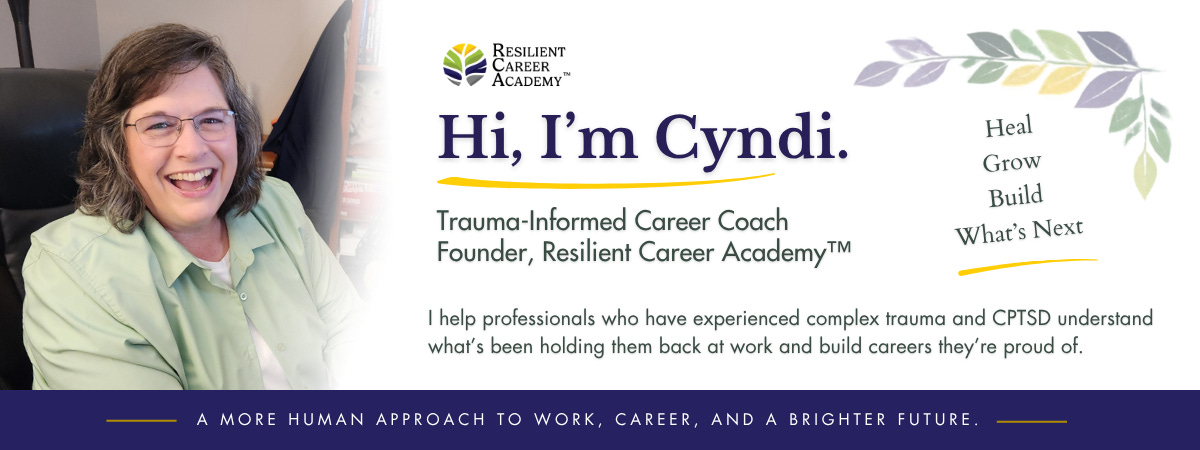
After spending more than 25 years navigating the corporate world, I understand how deeply our professional experiences can shape the way we see ourselves. I also understand how complex trauma can influence the choices we make, the opportunities we pursue, and the expectations we place on ourselves.
Today, we’re going to explore something traditional career development often overlooks: what happens to our sense of identity when we begin transitioning away from careers we’ve spent decades building.
We’ll talk about the emotional side of that transition, the desire to leave a meaningful legacy, and how we can begin preparing for a next chapter that reflects who we are becoming.
When Our Careers Become Part of Who We Are
Think about how often we introduce ourselves by telling people what we do for a living.
“I’m a project manager.”
“I’m a teacher.”
“I’m an executive.”
“I’m a nurse.”
For many of us, our professional roles become much more than descriptions of how we earn a living. They’re connected to our daily routines, our relationships, our accomplishments, and the ways we contribute to the world around us.
Over time, our careers can become woven into how we understand ourselves.
We may be the person others depend on to solve difficult problems. The one who knows how everything works. The person who can step into a complicated situation and figure out what needs to happen next.
There’s often a sense of pride that comes with developing that kind of expertise.
And after 25 or 30 years, we’ve invested an enormous amount of time, energy, and effort into becoming the professionals we are today.
But what happens when we begin imagining a future where those roles are no longer part of our everyday lives?
What happens when we’re no longer the person everyone calls when something goes wrong?
Or when the title we’ve worked so hard to earn no longer appears beside our name?
For some of us, those changes may feel exciting. For others, they may bring uncertainty, sadness, or a sense of loss.
And sometimes, we experience all of those feelings at once.
When Professional Identity and Personal Worth Become Entangled
This conversation can become even more complicated for those of us who’ve experienced complex trauma.
When we’ve spent years trying to prove our competence, earn approval, or establish a sense of security, our professional accomplishments can become deeply connected to how we measure our worth.
Maybe we’ve learned to feel valuable when we’re needed.
Maybe being the dependable one gives us a sense of belonging.
Or perhaps our professional achievements have become evidence we use to challenge an internal belief that we’re somehow not enough.
I recognize how powerful that can be.
And I also wonder what happens when the career we’ve relied on to provide that evidence begins to change.
If we’re no longer achieving, producing, solving problems, or meeting other people’s expectations in the same ways, where do we look for that sense of value?
That’s a question worth exploring before we reach the point of transition.
Because the skills, talents, and qualities that made us valuable contributors throughout our careers don’t disappear when we leave a particular position.
But we may need time to discover how we want to express those parts of ourselves differently.
Preparing for More Than a Financial Transition
When my husband and I met with our financial advisor, we were focused on whether we had enough money to retire.
And that was an important conversation.
But financial readiness is only one part of preparing for a major career transition.
We may also need to consider what our days will look like, where we’ll find connection and community, what will give us a sense of purpose, and how we’ll navigate the changes in our professional identity.
For someone who’s spent decades working within a structured environment, the idea of having fewer external expectations can be both appealing and unsettling.
We may discover that we’ve become so accustomed to organizing our lives around our careers that we haven’t spent much time imagining what we want outside of them.
And if we’re beginning to recognize how trauma responses have influenced our professional lives, there may be additional questions to explore.
What parts of our professional identity reflect who we genuinely are?
What parts developed because we were trying to feel safe, accepted, or capable?
And which parts do we want to carry into the next chapter?
These aren’t questions we have to answer overnight.
But they’re worth considering while we still have opportunities to make intentional choices about what comes next.
What Will Your Next Chapter Look Like?
After spending decades building a career, transitioning into something different can bring up questions we haven’t had much reason to consider before.
Who am I beyond my professional role? What do I want to do with the knowledge and experience I’ve accumulated? What would a meaningful next chapter look like for me?
These are questions we can explore together through individual career coaching.
Whether you’re considering retirement, a career change, consulting, entrepreneurship, or a different way to contribute, we can work together to explore your professional identity, identify what matters most to you, and develop a transition plan that reflects your goals, values, and circumstances.
You don’t have to have all the answers before we begin.
The Legacy We Want to Leave Behind
As we approach the later chapters of our careers, many of us begin asking different questions about success.
Earlier in our professional lives, we may have been focused on establishing ourselves, earning enough to support our families, advancing into new positions, or demonstrating what we were capable of accomplishing.
But as we begin thinking about what comes next, our attention may shift.
We may start wondering what difference we’ve made.
What knowledge or experience do we want to pass along?
What do we hope people will remember about the way we worked, led, supported others, or contributed?
And is there something we’ve always wanted to do that we haven’t yet given ourselves permission to explore?
Legacy can take many forms.
For some, it may mean mentoring younger professionals or sharing decades of industry knowledge.
For others, it might involve consulting, teaching, volunteering, advocating for changes in their profession, or building a business around something they care deeply about.
And for some, leaving a meaningful legacy may have less to do with professional accomplishments and more to do with the relationships they’ve nurtured and the lives they’ve touched along the way.
There’s no single definition of what a meaningful legacy should look like.
We deserve the opportunity to define it for ourselves.
We Still Have Something to Offer
In my last newsletter, What Kind of Work Would Jazz You?, we explored the idea that each of us brings a unique combination of gifts, talents, interests, skills, and lived experiences into the world.
That conversation becomes especially meaningful when we’re approaching a major career transition.
Because after 25 or 30 years in the workforce, we’ve accumulated an enormous amount of experience.
We’ve learned things that can’t always be taught in a classroom. We’ve developed judgment through practice. We’ve discovered what we’re good at, what interests us, and perhaps what we’d rather never do again.
And some of us may be discovering gifts and interests that haven’t had much opportunity to develop while we’ve been focused on our professional responsibilities.
What if the next chapter gives us an opportunity to use those gifts differently?
Maybe we’re ready to share what we’ve learned.
Maybe there’s a cause we’d like to support.
Maybe we’d like to pursue work that feels more aligned with our values.
Or maybe we want to create space for parts of ourselves that have received less attention throughout our careers.
We don’t have to keep doing what we’ve always done simply because we’ve become good at it.
And we don’t have to prove our value through another accomplishment to justify wanting something different.
We get to explore what a meaningful next chapter might look like for us.
The Next Chapter Is Still Ours to Write
When I think about the people who tell me they wish they’d discovered my work twenty years ago, I understand the longing behind those words.
I have my own list of things I wish I’d known sooner.
And while I can’t change the decisions I made with the information I had at the time, I can continue learning about myself and making choices about what I want my future to look like.
That’s true for many of us.
We may be approaching the end of a particular career, but that doesn’t mean we’re approaching the end of our opportunities to grow, contribute, connect, or find fulfillment.
Our professional identities may change.
Our priorities may evolve.
And our definitions of success may look different from the ones we carried earlier in our careers.
Perhaps that’s something worth welcoming with curiosity.
Because the career we’ve spent decades building is part of our story.
It doesn’t have to be the final chapter.
I’d Love to Hear From You
As you think about the next chapter of your life, I’d love to hear how you’re approaching professional identity and legacy.
When you imagine stepping away from the career you’ve built, what part of your professional identity do you most want to carry forward?
Maybe it’s a skill you’ve developed, a way you’ve helped others, a contribution you’re proud of, or something you’ve only recently begun to recognize about yourself.
I invite you to share your thoughts in the comments. There’s a great deal we can learn from one another about navigating these transitions and imagining what might still be possible.
"What happens when we're no longer the person everyone calls?" That's the question nobody schedules time for. Everyone plans the money part of a transition and skips the identity part — but figuring out who you are without the title was the real transition work for me too.