


A few days ago, someone left a comment on one of my YouTube Shorts that I’ve been thinking about ever since.
The video was from a conversation with Patrick LaRose about hypervigilance and the idea that some of the abilities we’ve developed through trauma can become “superpowers.”
But this person wasn’t experiencing hypervigilance as a superpower.
He described it as a curse. Something that had ruined his life. Something that left him overwhelmed whenever he went out in public.
He said he would have preferred to live an ordinary life.
My heart hurt for him.
Because I understood where he was coming from.
When something has caused us so much pain, especially over many years, hearing someone describe it as a “superpower” can feel impossible to reconcile with our own experience.
And I’ve been wondering whether what he really needed was for someone to acknowledge just how painful his experience has been.
Not to tell him that there’s something positive he can take away from it. Not to convince him that he should see things differently.
Just to recognize how much he’s been struggling.
His comment got me thinking about something much bigger than hypervigilance.
What happens when we’ve been trying so hard to get better, for so long, that we’re beginning to lose hope that anything will ever change?
That’s the conversation I want to have with you today.
If you’re new here, I’m Cyndi Bennett, a trauma-informed career coach and founder of the Resilient Career Academy.
After spending more than 25 years navigating the corporate world, I understand how deeply our professional experiences can shape the way we see ourselves.
Through my own journey as a trauma survivor, I’ve also come to understand how complex trauma can influence the choices we make, the opportunities we pursue, and the expectations we place on ourselves.
I write this newsletter to help professionals who have experienced complex trauma and CPTSD understand the patterns affecting their work, explore practical ways to respond, and build careers they’re proud of with support, compassion, and room for their own definition of success.
This week, we’re focusing on recognizing CPTSD and how childhood trauma may have followed us into our careers, and what it can mean when understanding those patterns hasn’t yet eased the pain.
If you’d like to keep having these conversations with me, subscribe for free here.
When Understanding Doesn’t Make the Pain Go Away
This week, we’ve been talking about what happens when we discover that we have CPTSD and begin recognizing how childhood trauma may have followed us into our careers.
For some of us, that discovery can explain things we’ve struggled to understand for years. Why feedback from a supervisor can feel so threatening. Why we anticipate problems before they happen. Why setting boundaries can leave us feeling guilty or afraid. Why we sometimes shut down, become overwhelmed, or find ourselves trying desperately to keep everyone happy. Why we may unintentionally sabotage our careers, pulling back from opportunities we want because being seen, taking a risk, or succeeding doesn’t feel safe.
We may begin recognizing patterns that have been part of our lives for so long that we assumed they were simply who we were.
And that understanding can bring relief.
But it can also bring grief.
We may begin looking back at all the years we spent struggling without understanding why. The opportunities we passed up. The relationships that were difficult to navigate. The energy we spent trying to manage things that other people didn’t seem to struggle with.
And then comes another question.
Now that I understand what’s happening, what am I supposed to do about it?
Because understanding why we struggle doesn’t automatically make the struggle go away.
We can recognize a trauma response and still experience it. We can understand why something triggers us and still find ourselves overwhelmed when it happens.
And when we’ve already spent years trying to change, it can be difficult to believe that learning one more thing will make any difference.
I Want You to Know That I See You
If you’ve spent years struggling with the effects of complex trauma, I want you to know something…
I see you.
I see how hard you’ve been trying to make sense of what’s happening to you. How exhausting it can be to walk into work already anticipating what might go wrong. How much energy it can take to manage your reactions, navigate relationships, and get through an ordinary workday.
I see the effort that other people may never recognize.
The times you’ve pushed through when you were overwhelmed. The opportunities you’ve avoided because something didn’t feel safe. The conversations you’ve replayed over and over, wondering whether you said or did something wrong.
And I see how discouraging it can be when you’ve tried so many things and still find yourself struggling.
I’m not going to tell you that your trauma was a gift. Or that you should be grateful for the abilities you developed because of it.
You don’t have to find a silver lining in your suffering.
What happened to you matters. What you’re experiencing now matters. And so does what you want your life and career to become.
I also want you to know that I believe change is possible.
That doesn’t mean the work will be easy, or that there’s a single solution that works for everyone. It means there are ways we can begin understanding these patterns, developing different responses, and creating conditions that support us instead of continually working against us.
And we don’t have to figure out how to do all of that alone.
There Is a Path Forward
One of the things I’ve learned through my own healing journey is that understanding what’s happening is an important beginning.
But awareness alone doesn’t create the changes we’re hoping for.
We also need opportunities to learn different ways of responding, practice what we’re learning, and discover what kinds of support will help us along the way.
That’s part of why I developed the 5 R Framework for building a more resilient career.
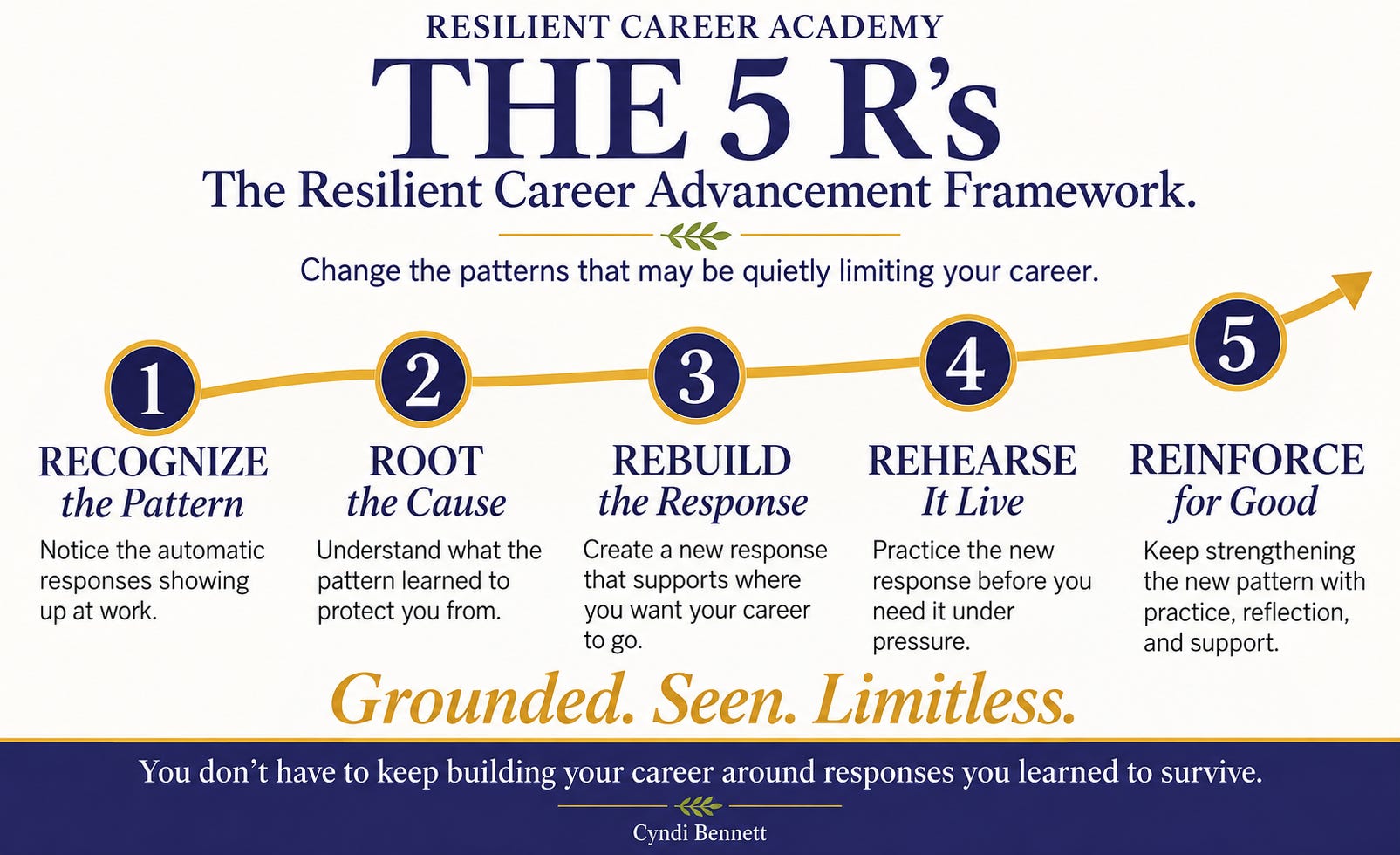
It’s a process we can use to begin working with the patterns that complex trauma may have created in our professional lives.
Recognize the Pattern. We begin noticing what’s happening. What situations trigger us? What do we experience in our bodies, thoughts, emotions, and behaviors? What patterns keep showing up?
Root Out the Cause. We explore what’s contributing to the response. Is something in our current environment genuinely unsafe? Is an earlier experience influencing how we’re interpreting what’s happening now? What choices and resources are available to us?
Rebuild the Response. We begin identifying other ways of responding that may help us navigate the situation. This might involve regulation skills, boundaries, communication, environmental changes, or additional support.
Rehearse It Live. We practice in real situations, starting with steps that feel manageable and safe enough. We don’t have to tackle the most difficult situation first.
Reinforce for Good. We reflect on what happened, learn from the experience, make adjustments, and continue practicing. Over time, some responses may become more accessible and familiar.
This isn’t a process we complete once and never revisit.
We may find ourselves working through these steps many times, with different situations and different patterns.
And there may be times when we need professional support, additional resources, or changes in our environment before we’re able to move forward.
But the important thing I want us to recognize is that there are things we can begin working on, even when we don’t yet know what the outcome will be.
We don’t have to figure out the entire journey before taking the next step.
Sometimes We Reach the Limits of What We Can Do Alone
I’ve been thinking about this in relation to my own experience as a trauma survivor building a business.
There have been so many things I’ve needed to learn.
Marketing. Developing a podcast. Understanding technology. Figuring out how to reach the people I want to serve. Learning how to build a sustainable business.
And for a long time, I approached those challenges the way I’d learned to approach so many things throughout my life.
I tried to figure them out myself.
I researched, experimented, learned new skills, and kept trying different approaches.
But I was working with the knowledge, resources, and capabilities I had at the time.
And at that point in my healing journey, asking for help was difficult for reasons that went much deeper than the business itself.
So I kept doing the best I could with what I knew.
Eventually, I began recognizing that there were limits to what I could accomplish on my own.
I hadn’t necessarily reached the limits of what was possible. I’d reached the limits of what I knew how to do by myself.
As I continued my healing journey, I became more able to ask for help and receive it.
And that made it possible to draw on knowledge, experience, and support that I hadn’t been able to access before.
Some of the possibilities that opened up weren’t the result of my learning to do everything myself.
They came from becoming able to let other people help me.
I share that because I wonder how often we find ourselves in a similar situation with our careers.
We may be doing everything we know how to do, yet still struggling.
And sometimes what we need isn’t another book, another strategy, or another attempt to push through.
Sometimes we need support we haven’t had before. A different perspective. A safer environment. Someone who understands what we’re experiencing and can help us identify options we haven’t been able to see.
Of course, asking for help isn’t always easy.
For many trauma survivors, there are very real reasons why we’ve learned to depend on ourselves. We may have experienced betrayal, disappointment, dismissal, or harm when we needed other people. Or we may have reached out for help, only to find that the people we were counting on didn’t show up for us.
Learning to recognize safe enough sources of support, build trust, and receive help can be part of the work itself.
And sometimes the support we need isn’t immediately available.
But I want us to remember that reaching the limits of what we’ve been able to do so far doesn’t mean we’ve reached the limits of what’s possible.
What If Things Really Can Be Different?
I keep thinking about the person who left that YouTube comment.
I don’t know what he’s tried, what kind of support he’s received, or what his experiences have been beyond what he shared.
And I wouldn’t presume to tell him that everything will get better.
But I wish he could know that his pain deserves to be acknowledged. That he doesn’t have to find something positive about his suffering for his experience to matter.
And that there may still be ways to reduce some of the suffering he’s experiencing, even if he can’t see them right now.
I want the same for you.
If you’ve just discovered that you have CPTSD, I hope understanding the connection between your past experiences and your current struggles gives you a starting point.
If you’ve known for years and are still struggling, I hope you’ll recognize that the work you’ve already done matters, even if the changes you’ve been hoping for haven’t happened yet.
And if you’re finding it difficult to believe that things can be different, I understand why.
Hope can be difficult when we’ve experienced so much disappointment.
We don’t have to manufacture optimism or pretend that everything is going to work out.
But perhaps we can begin by allowing for the possibility that there are things we haven’t learned yet, approaches we haven’t explored, or kinds of support we haven’t been able to access.
Our current experience is real. But it may not tell us everything about what’s possible in the future.
There is work involved in changing the patterns that have developed through trauma. Sometimes that work is slow, difficult, and frustrating. Sometimes progress happens in ways we don’t immediately recognize.
And sometimes we need to change the conditions around us, rather than continually asking ourselves to adapt to conditions that are hurting us.
We deserve support as we do that work.
You Don’t Have to Figure It All Out Alone
If you’re wondering where to begin, I’d like to offer you something practical.
My free Workplace Trigger Tracker Toolkit is designed to help us begin recognizing the situations that activate our trauma responses, what happens when we’re triggered, and the patterns that may be affecting our work.
It’s a starting point for understanding what’s happening so we can begin exploring what might help.
Get the Free Workplace Trigger Tracker Toolkit
And if you’re at a place where you’d like someone to come alongside you as you explore what’s happening in your career, I’d be honored to talk with you.
Through trauma-informed career coaching, we can look at the challenges you’re experiencing, the patterns that may be contributing to them, and the steps and support that could help you move toward the career you want to build.
Schedule a Free 30-Minute Consultation
I can’t promise that the path will be easy or that every challenge will disappear.
But I can promise that I’ll take your experiences seriously, listen without judgment, and work with you to explore what’s possible.
Because I see you.
I see how hard you’ve been trying.
And I believe your story is still being written.
Until next time,
Cyndi Bennett
Trauma-Informed Career Coach
Founder, Resilient Career Academy™
If this newsletter resonated with you, I’d love to hear what stood out. You can reply directly to this email or, if you’re reading on Substack, leave a comment below. You don’t have to have everything figured out to be part of this conversation.
Mmm..hmmm...my heart hurts for that, too.