


You know when you want to reach out to someone, but before you’ve even said hello, you’re already wondering if they’d rather you didn’t?
That’s where I’ve been lately. For a long time, I’ve wanted to reach out to some of the people who read this newsletter. If you’re reading this, I mean you. I’d love to know what brought you here and what’s been on your mind about work.
Then my mind starts in. What would I say? Would it seem creepy to reach out personally? Would you see my name in your inbox and think, “Another email?”
It’s funny how quickly I can go from wanting to say hello to imagining all the ways that hello might be unwelcome.
I’ve had the same experience in other parts of my coaching business. I’ve wanted to follow up with someone who expressed interest in coaching, then wondered if I’d come across as pushy. I’ve wanted to tell a business owner I admire how much I appreciated something they wrote, then worried they’d think I was about to ask for a favor.
And I’m starting to see a pattern. Each time, I have a reason I’d like to reach out. Then I start imagining how the other person might take it. Before I’ve written a word, I’m already responding to a conversation we haven’t had.
That’s the conversation I want to have with you today.
If you’re new here, I’m Cyndi Bennett, a trauma-informed career coach and founder of the Resilient Career Academy.
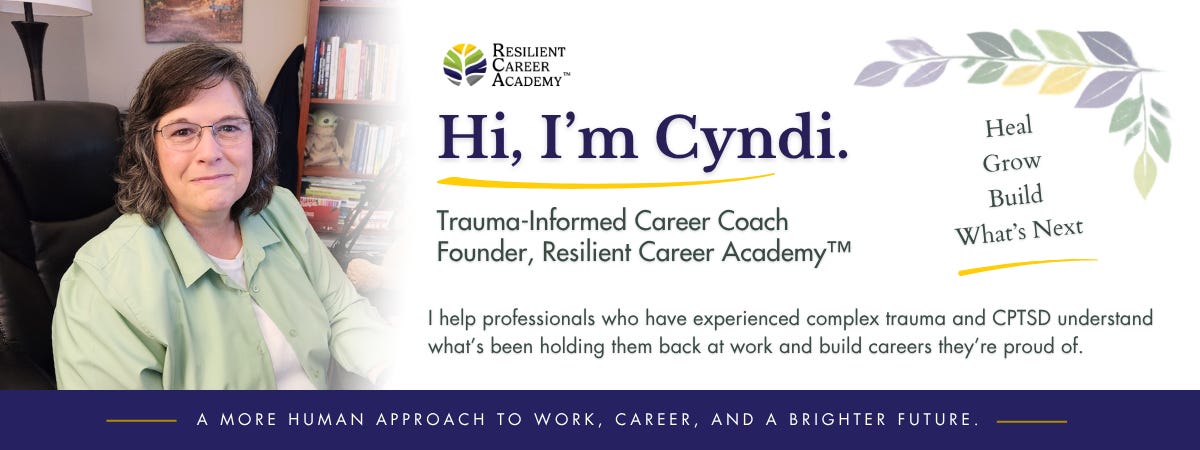
I spent more than 25 years in the corporate world, and I write about how our experiences as trauma survivors can show up in our working lives. Lately, I’ve been noticing how they show up in the business I’m building, too.
In case you missed it
I wrote about what can happen when we want to get to know someone and feel the urge to hide just as connection becomes possible. The piece is called:
Networking with CPTSD: When We Want to Connect and Hide

You know that moment when you’ve found someone you’d really like to connect with, but you can’t quite bring yourself to send the message?
I’ve been thinking about what that tension looks like when the people we’d love to get to know are also the people we hope to serve.
Two Business Owners Walk Into a Networking Event
I keep picturing two trauma survivors at a networking event for business owners. One is standing by the coffee, thinking, I’d love to meet her. I’ll wait until she’s finished getting her coffee.
The other is stirring a coffee she’s already stirred three times, thinking, I wish she’d come over. I’d go over there, but she looks like she’s waiting for someone.
A few minutes later, one of them finally says, “Have you been to one of these before?”
“No,” the other says. “Have you?”
“No. I was hoping you knew what we were supposed to do.”
And if you actually walked out of that networking event having said that much to another person, you would actually count that as a win!
When a Simple Hello Is Part of Making a Living
I can see myself on either side of that coffee table. I’ve gone to events hoping to meet people and spent more time than I’d like to admit trying to figure out whether they’d welcome a conversation.
I do want to respect people’s time. And I’m beginning to notice how quickly that can turn into deciding for someone else whether they’d want to hear from me.
When you’re building a business, those conversations are part of how you make a living. They’re how you learn what people need and how they find out whether you can help. A hello can lead to a conversation that helps you write something more useful, a referral from someone who understands what you do, or a chance to work with someone who’s been looking for exactly the kind of support you offer.
Any one of those moments can seem small. But when I keep talking myself out of reaching out, fewer people get to know what I do, and I have fewer chances to learn how I could serve them. Over time, that can affect how much I earn and whether the business can support me.
This is one of the things I’ve been thinking about as I put together an upcoming workshop for trauma survivors who are building businesses. How do we do the things our businesses depend on, like reaching out to people we’d love to work with, when those things can feel so uncomfortable? I’ll share more about the workshop soon.
One small step I’m taking for my own growth as a trauma survivor is to email a few of you who’ve been reading my work for a long time. I’m going to ask you if you’d like to hop on Zoom for a little chat.
I’d love to hear what’s kept you reading, what’s been hard about work or building a business lately, and what kind of support would actually help. I’m a little nervous about sending those emails. And when I picture us with our coffee, getting to know each other a little, I’m looking forward to it, too.
If We Were Standing by the Coffee
I’d love to know a little more about what you’re going through. It would help me write about the things that matter to you and be here with you through some of the harder parts.
If we were standing by the coffee, here’s what I’d ask you.
What’s been hard about work or building your business lately that you wish we talked about more?
If it’s easier to say it out loud, you can leave me a short voice message on SpeakPipe. A few words are plenty, or you can also reply to this email if you’d rather write.
And if all you want to say today is hello, I’d love to hear that, too.
Until next time,
Cyndi
Ways I Can Support You
Build a Business Without Living in Survival Mode Workshop
Bring the business problem that’s costing you the most right now. In this live, three-hour, trauma-informed workshop, you’ll work on one outcome that matters to you.
Protect what you earn. Practice naming your price or responding to a discount request with more confidence.
Protect your paid time. Practice telling a client what’s included and what would cost extra.
Find out if people want what you’re offering. Plan a way to share an offer or test a business idea with potential customers.
You’ll leave with a next step you can put to work in the business you’re running or thinking about starting.
Thursday, November 19 · 1–4 p.m. Eastern · Live online
Choose how you’d like to join
Attend the workshop only · $129 one-time
Join the live three-hour workshop and get 30 days of access to the replay of the teaching portions.Join the Resilient Career Academy · $149 per year
For $20 more, get this workshop and all RCA workshops and webinars during your membership year at no additional charge. You’ll also be part of a community where you can connect with other trauma survivors.
Already an active paid RCA member? Your workshop registration is included. Request your included registration.
Work with me through 1-on-1 trauma-informed career coaching
If something at work keeps leaving you overwhelmed, stuck, or second-guessing yourself, we can look at what’s happening and what might help you move forward. The first step is a free 30-minute consultation to talk about what you’re facing and see whether working together feels like a good fit.
Join the Resilient Career Academy
Connect with other trauma survivors who understand how complex trauma can show up at work. The RCA is a place to share what you’re going through, learn from one another, and take part in free workshops and webinars for members. Explore the RCA membership.
Get the free Workplace Trigger Tracker Toolkit
If you’d like a place to start on your own, the Workplace Trigger Tracker Toolkit can help you notice which situations at work bring up strong reactions and what helps you respond.
If someone comes to mind who’s navigating work or building a business as a trauma survivor, I’d love for you to share this newsletter with them. I hope it helps them feel a little less alone in what they’re going through.