


You know what you need to do. So why can’t you make yourself do it?
Publish the post. Send the proposal. Follow up with the potential client. Raise the price. Launch the offer. Record the video.
None of these things are especially complicated.
And yet you can spend hours researching, rewriting, reorganizing, preparing, or convincing yourself that you’ll do it tomorrow.
We often call that procrastination.
In entrepreneurship, we might decide we need more discipline, a better strategy, another productivity system, or maybe just more confidence.
But what if the thing you’re avoiding isn’t the task itself?
What if something about that task has activated a response that has very little to do with writing a post, sending an email, or naming a price?
What if your business has triggered you?
Entrepreneurship Can Activate More Than We Realize
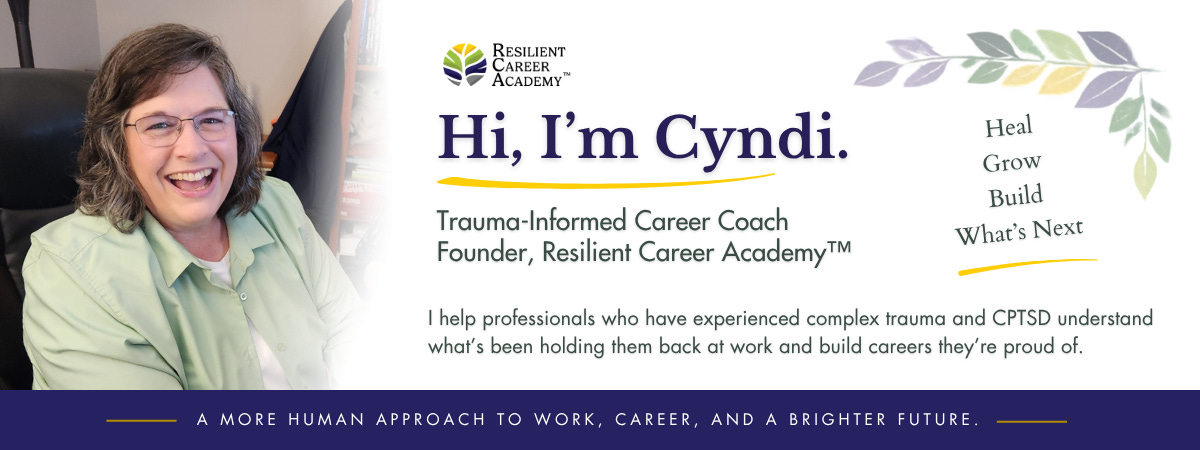
I’m Cyndi Bennett, a trauma-informed career coach and founder of the Resilient Career Academy.
After more than 25 years developing employees and leaders inside large organizations, I now help professionals understand how the aftereffects of complex trauma can show up in our careers and influence how we work, lead, communicate, and pursue what we want.
I’m also an entrepreneur.
And one of the things I’ve learned from building my own business is that entrepreneurship can create an entirely different environment for our old protective patterns to show up.
There are obvious reasons entrepreneurship can feel overwhelming. There’s financial uncertainty. There are endless decisions. We’re often doing jobs we’ve never done before. We may be the marketer, salesperson, strategist, content creator, bookkeeper, customer service department, and CEO, sometimes all before lunch.
But there’s another layer we don’t talk about nearly as much.
Entrepreneurship asks us to do things that can feel surprisingly vulnerable.
It asks us to be seen.
It asks us to tell people what we’re good at.
It asks us to put a price on something we’ve created.
It asks us to risk rejection.
It asks us to make decisions without knowing whether they’ll work.
It asks us to trust ourselves.
And for those of us whose earlier experiences taught us that visibility, mistakes, uncertainty, conflict, rejection, or getting something wrong could come with consequences, those aren’t always just business activities.
Sometimes they touch something much older.
An Ordinary Business Task Can Feel Anything but Ordinary
Imagine you’ve written a post promoting a new service.
You’ve read it five times. You change a sentence. Read it again. Change the opening. Decide the image isn’t right. Look for another one. Then you wonder whether you should be promoting the offer at all.
An hour later, the post still hasn’t been published.
From the outside, that might look like perfectionism or procrastination.
But what was happening inside?
Maybe publishing the post meant being visible.
Maybe talking about your expertise felt uncomfortably close to bragging.
Maybe asking someone to buy something brought up fears about being judged.
Maybe the possibility that nobody would respond felt like rejection.
Maybe there was an old message underneath all of it:
Who do you think you are?
That’s why I think it’s important that we become curious about what happens in these moments instead of immediately trying to correct the behavior.
Because if we decide the problem is procrastination when the real issue is that visibility doesn’t feel safe, another productivity hack probably isn’t going to solve it.
The Same Protective Patterns Can Follow Us Into Our Businesses
Many of the patterns that helped us navigate earlier environments don’t disappear simply because we become entrepreneurs.
They can come with us.
People-pleasing might look like saying yes to clients we know aren’t a good fit, changing our boundaries because we’re afraid someone will leave, or undercharging because naming the actual price feels uncomfortable.
Perfectionism might look like endlessly refining an offer, rewriting a website, taking one more course, or waiting until we feel completely ready before putting something into the world.
Hypervigilance might look like repeatedly checking email, watching analytics, interpreting a quiet week as evidence that the business is failing, or mentally running through every possible thing that could go wrong.
Avoidance might look like working very hard on everything except the one task that would actually move the business forward.
And overworking can be especially easy to justify because entrepreneurship always gives us something else we could be doing.
These patterns aren’t proof that we’re bad at business.
They are information.
The question becomes: What are they telling us?
Visibility Can Feel Like Exposure
Entrepreneurship often requires a level of visibility we may never have experienced in traditional employment.
We’re no longer representing someone else’s company. We’re representing ourselves.
Our ideas are ours. Our offers are ours. Our words are ours. Sometimes our face and our story are part of the business too.
That distinction matters.
Publishing something and receiving little response can feel different when the thing being received is ours. Someone declining an offer can feel different when we created the offer. Criticism can land differently when our name is attached to the work.
Even success can bring visibility that feels unfamiliar.
We might say we want a larger audience, more clients, speaking opportunities, or greater recognition, and then discover that being seen at that level creates discomfort we didn’t anticipate.
That doesn’t necessarily mean we don’t want the opportunity.
It may mean that part of us is still learning that being visible can be safe.
Money Can Become More Than Money
Money is another place where business and our past experiences can collide.
A slow month is a business reality.
But our nervous system may experience it as something much bigger.
Suddenly we’re not simply looking at revenue. We’re imagining everything that could happen if the business doesn’t work. We’re questioning our decisions. We’re wondering whether we made a terrible mistake. We’re comparing ourselves to other entrepreneurs who seem to be succeeding faster.
The distance between revenue is lower than I wanted this month, and I’m going to lose everything can become remarkably short.
And when we’re operating from that place, it can become difficult to distinguish a business decision from a fear response.
Do we actually need to change the offer?
Is the strategy not working yet?
Do we need more information?
Or are we trying to make the uncomfortable feeling go away as quickly as possible?
Those are very different questions.
Sometimes the Business Problem Isn’t Only a Business Problem
This is one of the most important things I’ve learned as I’ve built my own business.
When something isn’t working, my instinct can be to look for a business solution.
Maybe I need a better strategy.
Maybe I need to change the offer.
Maybe I need to learn more.
Maybe I need to work harder.
Sometimes that’s true.
But sometimes the strategy isn’t the thing standing in the way.
Sometimes I already know what I need to do, and I’m having difficulty doing it because of what the action represents.
Sending the pitch means risking rejection.
Raising the price means claiming the value of my work.
Publishing the article means allowing myself to be seen.
Setting a boundary means accepting that someone might not like it.
Launching the offer means finding out whether people want it.
At that point, the question changes.
Instead of asking:
Why can’t I make myself do this?
We can become curious:
What happens for me when I try?
Start With Curiosity, Not Judgment
That question creates room for something different.
We don’t have to immediately label ourselves as procrastinators, perfectionists, bad business owners, or people who simply need to try harder.
We can notice.
What happened right before I stopped?
What did I start thinking about?
What did I feel in my body?
What outcome was I afraid might happen?
What did avoiding the task allow me not to experience?
And perhaps most importantly:
What might I need in order to take the next step?
This isn’t about analyzing every uncomfortable moment or attributing every business challenge to trauma.
Sometimes business is simply difficult. Sometimes a strategy doesn’t work. Sometimes we need better information, stronger skills, different support, or more practice.
But when we notice the same response appearing again and again, especially around visibility, rejection, money, boundaries, uncertainty, or claiming our expertise, it may be worth getting curious about the pattern.
Recognition gives us something judgment doesn’t.
Choice.
We Don’t Have to Build Our Businesses Against Ourselves
There is a version of entrepreneurship that says success requires us to push harder, become more disciplined, tolerate more discomfort, and keep going no matter what.
I don’t believe that’s the only way to build something meaningful.
What if we could build businesses with a better understanding of ourselves?
What if we could recognize when an old protective response has entered a present-day business decision?
What if we could learn which situations activate us, understand what those responses are trying to protect us from, and begin experimenting with different ways of responding?
And what might become possible if we weren’t spending so much energy fighting ourselves while trying to build something we care about?
For trauma survivors who become entrepreneurs, I think that’s an important conversation.
Because the goal isn’t to create a business in which we’re never uncomfortable, never uncertain, never rejected, and never triggered.
Entrepreneurship probably isn’t going to give us that.
The possibility is that we can become increasingly aware of what is happening inside us, learn how to work with those responses, and make more of our business decisions from the present instead of allowing the past to quietly make them for us.
And that can change not only how we experience entrepreneurship.
It can change what we’re able to build.
What Are You Noticing in Your Business?
If you’ve recognized yourself somewhere in this article, you don’t have to immediately figure out how to change it.
Start by noticing.
The next time you find yourself avoiding something you know you need to do, getting caught in perfectionism, overthinking a decision, or feeling unexpectedly activated by something happening in your business, pause long enough to become curious about what’s happening.
Instead of asking, Why am I doing this again?, try asking:
What about this feels difficult for me right now?
You may not have an answer immediately. That’s okay. Recognition comes before change.
The more we begin to notice where our past experiences are influencing our present-day business decisions, the more opportunity we have to make those decisions differently.
And that’s where possibility begins.
I’d also love to hear what you’re noticing. I’m exploring the intersection of trauma and entrepreneurship more deeply in this series, and I want these conversations to reflect what entrepreneurs with trauma histories are actually experiencing, not what we’re supposed to be experiencing.
What part of entrepreneurship activates something in you that you didn’t expect?
Leave a comment, or reply directly to this email if you’d rather share privately. What you tell me will help shape where we take this series next.
The trigger framing is the part most productivity advice skips. When the business pokes an old wound, no amount of time-blocking touches it, because the overwhelm isnt really about the calendar. What helped me was noticing which tasks I kept avoiding and asking what they actually represented, rather than trying to power through faster. Thanks for naming it this plainly.